

Tensile Testing vs Hardness Testing: What’s the Difference?
Mechanical testing is essential for evaluating material performance, verifying manufacturing quality, and ensuring products meet engineering and regulatory requirements. Among the most commonly performed mechanical tests are tensile testing and hardness testing. Although both methods assess mechanical properties, they measure different characteristics and serve different purposes.
Understanding the differences between tensile testing and hardness testing helps manufacturers, engineers, and quality professionals select the appropriate test for product development, quality control, supplier evaluation, and compliance verification.
What Is Tensile Testing?
Tensile testing evaluates how a material behaves when subjected to a controlled pulling force until it deforms and eventually fractures.
The test measures a material’s ability to withstand tensile loads and provides detailed information about its mechanical performance.
Common mechanical properties obtained from tensile testing include:
- Ultimate tensile strength (UTS)
- Yield strength
- Elongation at break
- Reduction of area
- Modulus of elasticity
Because tensile testing measures material behavior throughout the entire loading process, it is one of the most comprehensive mechanical tests available.
What Is Hardness Testing?
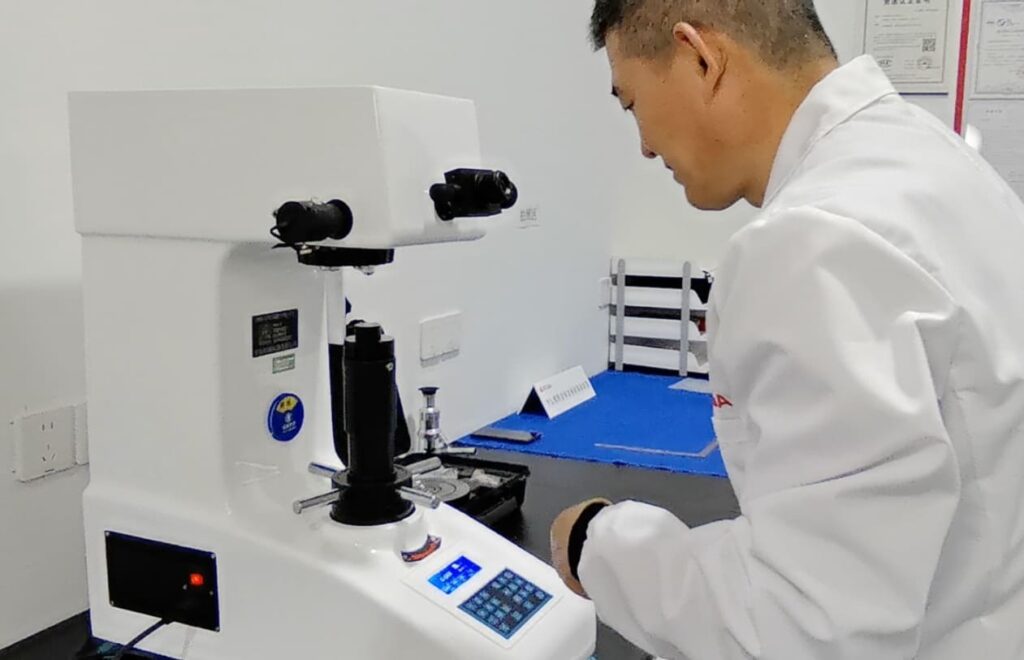
Hardness testing measures a material’s resistance to permanent indentation under a controlled force.
Instead of pulling the material until failure, hardness testing applies a specified load using a standardized indenter and measures the resulting indentation depth or size.
Common hardness testing methods include:
- Rockwell Hardness Testing
- Vickers Hardness Testing
- Brinell Hardness Testing
Hardness testing provides a fast and reliable indication of surface hardness and is widely used for production inspection and heat treatment verification.
Key Differences Between Tensile Testing and Hardness Testing
Although both tests evaluate mechanical properties, they measure different material characteristics.
| Feature | Tensile Testing | Hardness Testing |
| Purpose | Evaluates behavior under tensile load | Measures resistance to indentation |
| Primary Result | Strength and ductility | Surface hardness |
| Test Method | Pulls the specimen until fracture | Creates a controlled indentation |
| Specimen Damage | Destructive | Usually minimally destructive |
| Testing Time | Longer | Faster |
| Equipment | Universal Testing Machine (UTM) | Hardness Tester |
| Typical Standards | ISO 6892-1, ASTM E8/E8M | ISO 6508, ISO 6507, ASTM E18 |
What Mechanical Properties Does Each Test Measure?
Each testing method provides different information about material performance.
Tensile Testing Measures
- Tensile strength
- Yield strength
- Elongation
- Ductility
- Stiffness
- Fracture behavior
These properties help engineers evaluate how materials perform under actual service loads.
Hardness Testing Measures
- Surface hardness
- Resistance to indentation
- Wear resistance
- Heat treatment effectiveness
- Surface consistency
Hardness values are often used for routine quality verification during production.
When Should Tensile Testing Be Used?
Tensile testing is appropriate when complete mechanical property data is required.
Typical applications include:
- Material qualification
- Product development
- Engineering design
- Material comparison
- Supplier evaluation
- Product certification
- Failure analysis
Because the specimen is pulled until fracture, tensile testing provides detailed insight into material behavior under load.
When Should Hardness Testing Be Used?
Hardness testing is commonly selected when fast, repeatable measurements are needed during manufacturing.
Typical applications include:
- Incoming material inspection
- Heat treatment verification
- Production quality control
- Surface hardness verification
- Process monitoring
- Batch consistency evaluation
Since only a small indentation is created, hardness testing is often performed on finished components.
Common Industries That Use Both Tests
Many industries use tensile testing and hardness testing together to obtain a more complete understanding of material performance.
Automotive Industry
Verifies structural strength while confirming proper heat treatment of gears, shafts, and fasteners.
Aerospace Industry
Evaluates high-strength alloys used in aircraft structures and engine components.
Construction Industry
Confirms the mechanical properties of structural steel, reinforcement bars, and fabricated components.
Manufacturing Industry
Supports material verification, production monitoring, and supplier quality management.
Metal Fabrication Industry
Validates raw materials and finished components before delivery to customers.
Can Tensile Strength Be Estimated from Hardness?
For some metallic materials, hardness values can provide an approximate indication of tensile strength. However, the relationship depends on the material type, heat treatment condition, and manufacturing process.
Hardness testing should not be used as a direct replacement for tensile testing when engineering calculations, certification, or compliance verification require actual tensile properties.
Whenever accurate values for yield strength, tensile strength, or elongation are needed, tensile testing remains the preferred method.
How Tensile Testing and Hardness Testing Support Quality Control
Manufacturers often use both testing methods at different stages of production.
Tensile Testing Supports
- Product development
- Material approval
- Supplier qualification
- Compliance verification
- Failure investigation
Hardness Testing Supports
- Incoming inspection
- Process control
- Heat treatment verification
- Final inspection
- Production consistency
Together, these tests provide complementary information that helps manufacturers maintain consistent product quality and reduce the risk of material failure.
Choosing the Right Test for Your Product
The appropriate testing method depends on the inspection objective.
Choose tensile testing when you need to:
- Evaluate complete mechanical properties
- Verify material strength
- Support engineering calculations
- Meet tensile testing requirements in product standards
Choose hardness testing when you need to:
- Perform fast production inspections
- Verify heat treatment results
- Measure surface hardness
- Monitor manufacturing consistency
In many applications, using both methods provides the most comprehensive assessment of material quality.
Tensile testing and hardness testing evaluate different aspects of material performance and should be selected based on the intended application and testing objectives. Tensile testing measures strength, ductility, and fracture behavior under controlled loading, while hardness testing provides a fast assessment of surface resistance to indentation and wear. Understanding the strengths of each method helps manufacturers select the appropriate test, improve quality control, and ensure products meet customer and industry requirements.

 Request Free Sample Report