

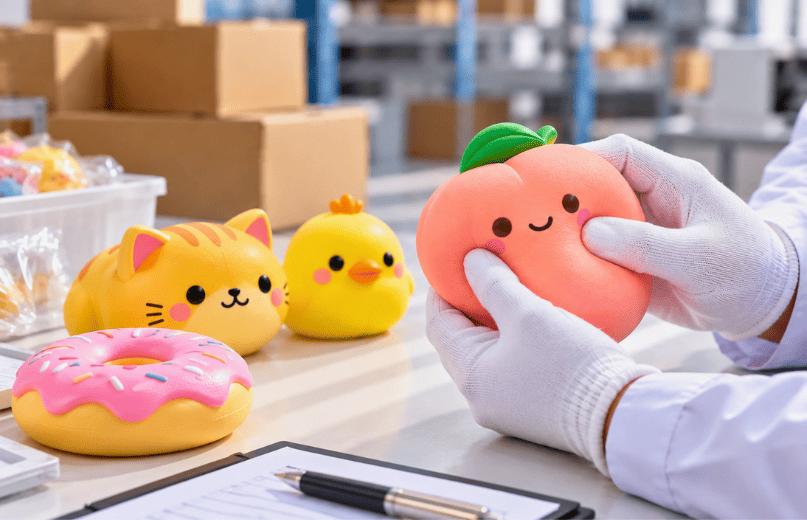
Squishy Toy Quality Control: Inspection Checklist and Safety Requirements
Squishy toys are soft, squeezable toys commonly made from polyurethane (PU) foam or other flexible materials designed to compress and gradually return to their original shape. Their quality depends on foam consistency, shape recovery, surface finishing, printing, durability, and compliance with applicable toy safety requirements.
Squishy toy quality control can be conducted during production and before shipment to identify problems such as cracks, tears, poor shape recovery, surface defects, strong odors, incorrect dimensions, and damaged packaging.
For products intended for children, physical inspection should be combined with appropriate laboratory testing to verify compliance with the toy safety requirements of the destination market.
Why Squishy Toy Quality Control Is Important
Squishy toys are repeatedly squeezed, stretched, and handled during normal use. Poor foam quality or manufacturing controls can result in tearing, permanent deformation, peeling coatings, weak attached parts, or inconsistent recovery performance.
An effective quality control program helps:
- Verify product appearance and workmanship
- Check foam consistency and shape recovery
- Identify cracks, tears, and surface defects
- Verify dimensions and weight
- Check printed and painted surfaces
- Evaluate attached components
- Confirm labeling and packaging
- Identify quality problems before shipment
- Support compliance with applicable toy safety requirements
Inspection criteria should be established according to the approved sample, product specification, intended age group, and destination market.
Types of Inspection for Squishy Toys
Squishy toys can be inspected at different stages of production depending on the supplier, order size, and quality requirements.
| Inspection Type | Purpose |
| Pre-Production Inspection (PPI) | Verify materials, components, approved samples, and production readiness |
| During Production Inspection (DUPRO) | Identify foam, molding, printing, and workmanship problems during production |
| Pre-Shipment Inspection (PSI) | Inspect finished squishy toys and packaging before shipment |
| Container Loading Supervision (CLS) | Verify quantities, cartons, container condition, and loading |
For new products or suppliers, checking production before the entire order is completed can help identify recurring manufacturing problems earlier.
Squishy Toy Inspection Checklist
A squishy toy inspection should evaluate the finished product against approved samples, specifications, purchase orders, packaging requirements, and defined acceptance criteria.
Appearance and Workmanship
Inspectors examine the overall appearance and finishing of each selected sample.
Typical checks include:
- Correct shape
- Surface condition
- Color consistency
- Printing quality
- Paint application
- Visible cracks
- Tears
- Holes
- Dents
- Deformation
- Excess material
- Dirt or stains
- Glue marks
- Poor trimming
For character-shaped squishy toys, details such as eyes, facial features, patterns, and decorative elements should match the approved artwork or reference sample.
Foam and Material Quality
Foam quality has a direct effect on the feel, durability, and recovery performance of a squishy toy.
Inspectors may check:
- Foam consistency
- Surface texture
- Softness
- Density consistency
- Air pockets
- Voids
- Cracking
- Uneven molding
- Permanent deformation
Products from the same production lot should have reasonably consistent appearance and physical characteristics according to the approved specification.
Laboratory testing may be required to evaluate chemical properties or material safety that cannot be determined through visual inspection.
Shape Recovery
Shape recovery is an important functional characteristic for slow-rising squishy toys.
During inspection, a sample may be compressed according to an agreed procedure and observed to determine whether it returns to its expected shape.
Inspectors may check for:
- Recovery after compression
- Permanent deformation
- Uneven recovery
- Failure to return to the original shape
- Cracking after compression
- Surface damage after repeated squeezing
If a specific recovery time is required, the acceptance criteria should be defined in the product specification so that results can be measured consistently.
Dimensions and Weight
Inspectors may verify product dimensions against the approved specification.
Checks can include:
- Height
- Width
- Length
- Thickness
- Product weight
Significant variation can indicate inconsistent molding, material quantity, or production control.
Tolerances should be established before inspection.
Surface Coating and Printing
Many squishy toys use painted, printed, or coated surfaces to create characters, patterns, and decorative details.
Inspectors typically check for:
- Peeling
- Flaking
- Cracking
- Color variation
- Missing print
- Misaligned print
- Smudging
- Poor coverage
- Color transfer
- Surface scratches
Surface decoration should remain reasonably intact during normal handling according to the agreed product requirements.
Applicable chemical requirements for paints, coatings, and toy materials should be evaluated separately through appropriate laboratory testing.
Odor
PU foam, adhesives, coatings, inks, and packaging materials may produce noticeable odors.
During inspection, inspectors can identify whether products have an unusual or strong odor compared with the approved sample or agreed acceptance criteria.
A sensory odor check does not determine whether a product contains restricted or hazardous chemicals. Chemical compliance requires appropriate laboratory analysis.
Attached Parts and Accessories
Some squishy toys include keychains, straps, charms, plastic accessories, or other attached components.
Inspectors may verify:
- Component attachment
- Correct accessories
- Assembly quality
- Missing parts
- Broken components
- Loose attachments
- Sharp or damaged components
For toys intended for young children, small parts and detachable components may also be subject to specific safety requirements based on the intended age group and destination market.
Labels and Packaging
Packaging protects squishy toys against deformation, dirt, moisture, and damage during transportation and storage.
Inspectors may verify:
- Product packaging
- Polybags
- Retail boxes
- Display packaging
- Warning labels
- Age grading
- Product information
- Barcodes
- Country of origin marking
- Tracking information where applicable
- Carton markings
- Packing quantity
The required warnings and labeling depend on the product design, intended age group, and destination market.
Common Squishy Toy Defects
Several defects can occur during foam molding, curing, finishing, printing, assembly, and packaging.
| Defect | Description |
| Cracked Surface | Visible cracking in the foam or coating |
| Foam Tear | Material tears during handling or compression |
| Poor Recovery | Product does not return properly to its original shape |
| Permanent Deformation | Product remains distorted after compression |
| Air Holes or Voids | Visible cavities or irregularities in the foam |
| Peeling Coating | Painted or coated surface separates from the foam |
| Printing Defect | Missing, blurred, or misaligned decoration |
| Color Variation | Product color differs between units or from the approved sample |
| Incorrect Shape | Molded shape does not match the approved specification |
| Strong Odor | Product has an unusual or excessive odor |
| Loose Accessory | Attached component is inadequately secured |
| Stains or Dirt | Visible contamination affects product appearance |
| Packaging Damage | Retail or transport packaging is torn, crushed, or damaged |
Defect classifications should be agreed before inspection so that critical, major, and minor defects can be evaluated consistently.
AQL Sampling for Squishy Toy Inspection
Third-party inspections commonly use Acceptance Quality Limit (AQL) sampling to determine the number of products selected from a shipment for inspection.
Samples are randomly selected from the inspection lot and defects are classified according to their severity.
| Classification | Description |
| Critical Defects | Safety or regulatory issues that make the product unacceptable |
| Major Defects | Problems that significantly affect function, durability, appearance, or customer acceptance |
| Minor Defects | Smaller workmanship or cosmetic imperfections with limited impact on normal use |
The applicable inspection level, AQL values, sample size, and acceptance criteria should be agreed between the buyer and supplier.
Common Functional Checks for Squishy Toys
Functional checks help determine whether the product performs consistently during normal handling.
Compression and Recovery Check
The toy is compressed and released to evaluate whether it returns to its expected shape without permanent deformation.
Repeated Squeeze Check
Selected samples may be squeezed repeatedly according to an agreed inspection procedure to identify cracking, tearing, coating damage, or deterioration.
Surface Rub Check
A basic rub check may be performed when required to identify obvious color transfer or weak surface decoration.
Accessory Attachment Check
Keychains, straps, loops, and other attached components can be checked for secure assembly according to the defined inspection procedure.
These on-site checks provide information about workmanship and basic functionality. Formal mechanical, physical, or chemical compliance testing should follow the applicable laboratory test methods.
Squishy Toy Safety Testing and Standards
Toy safety requirements depend on the destination market, intended age group, materials, and product design.
For squishy toys, applicable requirements may address mechanical and physical hazards, small parts, material composition, surface coatings, restricted substances, labeling, and other safety characteristics.
United States
Children’s toys sold in the United States are subject to applicable requirements under ASTM F963, which is incorporated into federal regulation under 16 CFR Part 1250. The currently mandatory version is ASTM F963-23 for toys manufactured on or after April 20, 2024.
ASTM F963 covers a range of toy hazards, and the applicable sections depend on the specific toy design. CPSC guidance specifically includes requirements for areas such as material quality, surface coatings, toy substrates, small objects, and squeeze toys where applicable.
For children’s toys intended primarily for children 12 years old or younger, applicable children’s product safety rules generally require third-party testing by a CPSC-accepted laboratory and certification through a Children’s Product Certificate (CPC).
European Union
Squishy toys placed on the EU market must comply with applicable EU toy safety requirements. Depending on the product, testing may include relevant parts of the EN 71 series, covering mechanical and physical properties, flammability, and migration of certain elements.
The applicable tests should be determined according to the toy’s materials, design, age grading, and intended use.
Chemical Testing
Depending on the market and product materials, laboratory testing may be required for substances such as:
- Heavy metals
- Phthalates
- Restricted chemicals
- Substances in surface coatings
Chemical safety cannot be reliably evaluated through visual product inspection. Appropriate laboratory testing should be completed according to the regulations and standards applicable to the destination market.
Common Inspection Equipment
Inspectors may use different equipment depending on the squishy toy and inspection scope.
Typical equipment includes:
- Measuring tape or ruler
- Vernier caliper
- Digital weighing scale
- Stopwatch for defined recovery-time checks
- Barcode scanner
- Approved sample or color reference
- Digital camera
- Inspection checklist
Additional equipment may be required when specific on-site checks are included in the inspection protocol.
Squishy toy quality control should verify foam condition, workmanship, appearance, shape recovery, dimensions, surface decoration, accessories, labeling, and packaging before shipment. For children’s products, inspection should be supported by applicable toy safety testing based on the intended age group and destination market.
A defined inspection checklist, approved reference sample, measurable acceptance criteria, and appropriate laboratory testing provide a stronger basis for controlling squishy toy quality before products enter the market.

 Request Free Sample Report