

Powder Coating Thickness: How Many Microns Are Required?
Powder coating thickness refers to the thickness of the cured coating film applied to a metal surface. It is usually measured in microns (µm) or mils.
Many general-purpose powder coating applications specify a thickness of 60–80 microns (µm). Confirm the required range in the applicable coating or product specification, taking into account the powder formulation, substrate, coating system, service environment, and performance requirements.
A coating that is too thin may provide inadequate coverage and corrosion protection. Excessive thickness can cause appearance problems, dimensional issues, and unnecessary material consumption.
What Is Powder Coating Thickness?
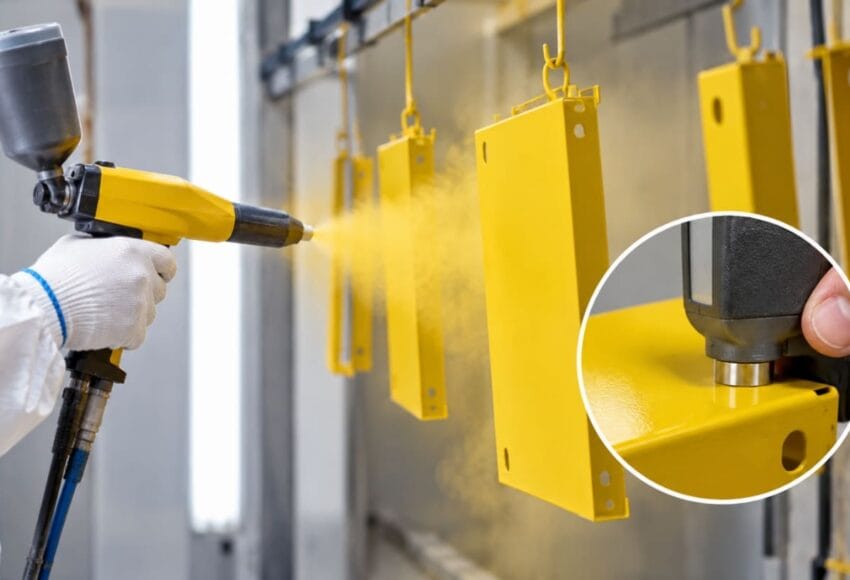
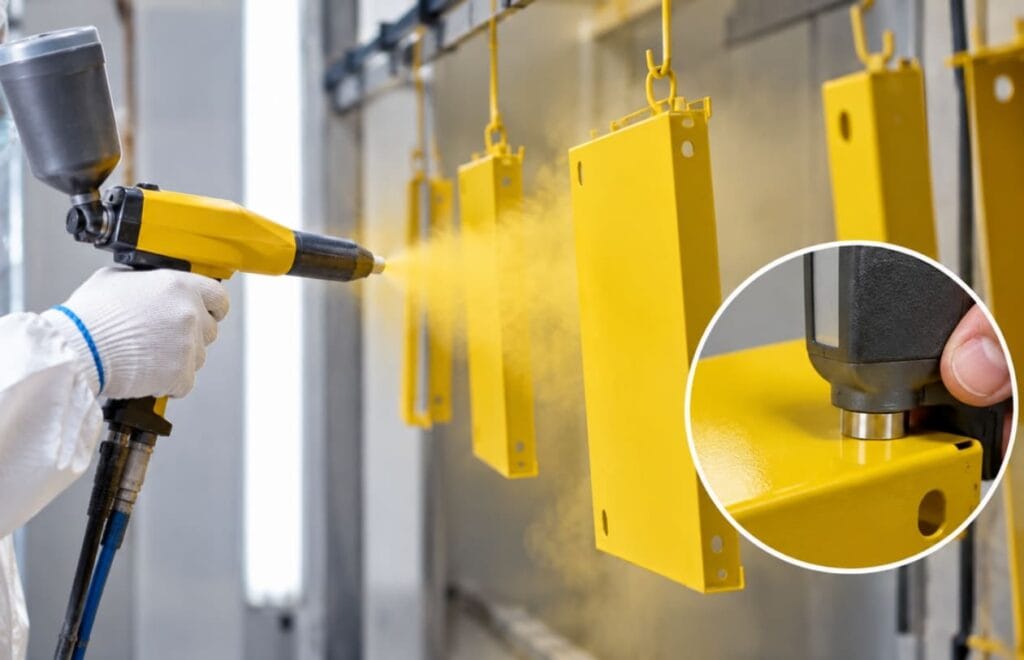
Powder coating is normally applied electrostatically as a dry powder and then cured in an oven. During curing, the powder melts and forms a continuous coating over the substrate.
The thickness of this cured layer is known as dry film thickness (DFT).
Common units are:
- Micron (µm) for metric specifications
- Mil for imperial specifications
One mil equals 25.4 microns.
| Microns | Approx. Mils |
| 40 µm | 1.6 mils |
| 50 µm | 2.0 mils |
| 60 µm | 2.4 mils |
| 80 µm | 3.1 mils |
| 100 µm | 3.9 mils |
| 120 µm | 4.7 mils |
| 150 µm | 5.9 mils |
How Many Microns Should Powder Coating Be?
For many conventional powder coatings, 60–80 µm is a useful general reference.
Typical ranges may look like this:
| Application | Typical Powder Coating Thickness* |
| Thin-film applications | 40–60 µm |
| General-purpose powder coating | 60–80 µm |
| Higher-build coatings | 80–120 µm |
| Primer + topcoat systems | Often above 100 µm total |
| Specialized functional coatings | Product-specific |
*These are general reference ranges. The actual requirement should follow the approved coating specification or powder manufacturer’s technical data sheet.
A product specification may therefore require 50 µm, 60–80 µm, 80–100 µm, or another range depending on the coating system.
Is 60–80 Microns a Standard Powder Coating Thickness?
60–80 µm is common, but it is not a universal standard requirement.
Powder coating manufacturers specify recommended film builds according to the properties of individual coating products. Some coating systems are designed around approximately 60–80 µm, while others require higher or lower film thickness.
Multi-layer systems can also have significantly greater total thickness. For example, an anti-corrosion system may contain a powder primer followed by a powder topcoat, with the thickness specified separately for each layer.
The correct value should therefore be taken from:
- Powder manufacturer’s technical data sheet
- Product specification
- Engineering drawing
- Customer requirement
- Applicable coating standard
What Happens If Powder Coating Is Too Thin?
A powder coating below its specified thickness may have insufficient film build to provide the intended performance.
Common problems include:
Incomplete Coverage
Areas of the substrate may remain insufficiently covered, particularly around difficult geometries.
Poor Appearance
Thin coating can result in inconsistent color, reduced opacity, or visible substrate.
Reduced Corrosion Protection
Insufficient coating thickness may reduce the barrier between the metal substrate and the surrounding environment.
Uneven Performance
A component may have acceptable thickness on large flat surfaces but insufficient coating around corners, recesses, or other difficult-to-coat areas.
This is why thickness should normally be measured at several representative locations.
What Happens If Powder Coating Is Too Thick?
More coating does not automatically produce better performance. Powder coatings are formulated to operate within specified film-build ranges.
Excessive thickness can contribute to:
- Orange peel
- Uneven surface appearance
- Loss of fine surface detail
- Dimensional problems
- Assembly interference
- Changes in mechanical properties
- Increased powder consumption
High-build powder coatings and multi-layer systems can legitimately exceed 100 µm. Their acceptance should be based on the requirements of the specific coating system.
Powder Coating Thickness for Indoor and Outdoor Products
The intended environment influences coating selection and thickness requirements.
Indoor Products
Powder coating is commonly used on:
- Furniture
- Shelving
- Cabinets
- Appliances
- Electrical enclosures
- Decorative metal products
A 60–80 µm range is frequently encountered for general applications, subject to the powder specification.
Outdoor Products
Outdoor products may face moisture, UV exposure, temperature changes, pollution, and other environmental stresses.
Examples include:
- Outdoor furniture
- Metal railings
- Architectural components
- Electrical enclosures
- Outdoor equipment
Thickness is only one part of outdoor coating performance. Powder chemistry, substrate preparation, pretreatment, curing, and coating coverage also need to meet the intended requirements.
Powder Coating Thickness and Corrosion Resistance
Powder coating forms a protective barrier over the underlying metal. Maintaining the specified thickness helps ensure that the coating provides the intended coverage.
Corrosion performance also depends on:
- Substrate material
- Surface preparation
- Pretreatment
- Powder formulation
- Curing conditions
- Edge coverage
- Coating defects
- Mechanical damage
Two products can therefore have the same 80 µm coating thickness and still show different corrosion performance.
For example, a properly pretreated steel component with a uniform coating may perform differently from a component with contamination or poor pretreatment, even when both have the same measured film thickness.
Does a Thicker Powder Coating Pass More Salt Spray Hours?
Powder coating thickness and salt spray test duration are specified separately. Pairings such as the examples below should be used only when stated in the applicable product or coating specification:
- 60 µm and 240 hours
- 80 µm and 500 hours
- 100 µm and 1,000 hours
Salt spray performance is evaluated against the complete coating system, test method, and specified acceptance criteria.
Standards such as ISO 9227 and ASTM B117 establish controlled salt spray test methods. The required exposure duration and acceptance criteria normally come from the relevant product, coating, or customer specification.
Coating thickness measurement and salt spray testing therefore evaluate different properties:
| Test | What It Evaluates |
| Coating thickness test | Thickness of the applied coating |
| Salt spray test | Corrosion performance under specified exposure |
| Cross-cut test | Coating adhesion |
| Cure test | Condition of the cured coating |
These tests can be used together when a more complete evaluation of a powder coating system is required.
How Is Powder Coating Thickness Measured?
Powder coating thickness is commonly measured after curing using a coating thickness gauge. The appropriate measurement method depends on the coating and substrate. For a broader explanation of magnetic, eddy-current, ultrasonic, and other methods, see our guide to coating thickness testing.
Powder Coating on Steel
Steel is a ferrous substrate. Magnetic coating thickness measurement can be used to measure non-magnetic powder coatings over steel.
ISO 2178 is one of the relevant standards for measuring non-magnetic coatings on magnetic basis metals.
Powder Coating on Aluminium
Aluminium is a non-ferrous conductive substrate. Eddy-current measurement is commonly used for non-conductive coatings applied over aluminium.
ISO 2360 covers eddy-current measurement of non-conductive coatings on non-magnetic electrically conductive basis metals.
ASTM D7091 is another commonly referenced practice for nondestructive dry film thickness measurement on ferrous and non-ferrous metal substrates.
Where Should Powder Coating Thickness Be Measured?
A single measurement may not represent the coating thickness across an entire product.
Powder deposition can vary because of:
- Product geometry
- Edges and corners
- Recessed areas
- Electrostatic effects
- Gun position
- Grounding
- Application technique
Measurements should therefore be taken at representative locations according to the applicable specification.
Particular attention may be required around:
- Flat surfaces
- Corners
- Edges
- Recesses
- Bends
- Welded areas
- Critical assembly locations
Several readings provide a more reliable indication of coating uniformity than one isolated measurement.
Why Does Powder Coating Thickness Vary?
Electrostatic powder application can produce different film builds across complex components.
One common issue is the Faraday cage effect. Deep recesses, internal corners, channels, and similar areas can be difficult to coat uniformly because of the electrostatic field around the component.
Other causes of thickness variation include:
- Poor grounding
- Incorrect gun distance
- Inconsistent spray speed
- Incorrect powder output
- Complex component geometry
- Manual touch-up
Thickness measurements can help identify these process variations during production.
Powder Coating Thickness and Adhesion
Meeting the required thickness does not confirm that the coating has adequate adhesion.
Poor adhesion can result from:
- Contaminated surfaces
- Inadequate pretreatment
- Incorrect curing
- Surface oxidation
- Process contamination
Where adhesion verification is required, a cross-cut adhesion test may be performed. ISO 2409 is commonly used for cross-cut testing of paints and varnishes.
Thickness and adhesion therefore provide different information about coating quality.
A coating may measure 70 µm and meet its thickness specification while still failing an adhesion test.
Powder Coating Thickness and Curing
Correct film thickness also does not confirm correct curing.
Powder coatings require defined curing conditions, typically based on the powder manufacturer’s technical data sheet.
Under-curing can affect coating performance even when the measured thickness is correct.
Powder coating quality control should therefore consider:
- Film thickness
- Cure condition
- Adhesion
- Surface appearance
- Corrosion resistance, where required
Powder Coating Thickness Inspection Checklist
A practical powder coating inspection can include:
| Check | What to Verify |
| Powder type | Correct approved powder |
| Substrate | Correct base material |
| Pretreatment | Required preparation completed |
| Required thickness | Specified micron range |
| Measurement method | Suitable for substrate |
| Gauge | Verified before use |
| Measurement locations | Representative surfaces |
| Minimum thickness | Meets specification |
| Maximum thickness | Within limit where specified |
| Uniformity | No abnormal variation |
| Appearance | No visible coating defects |
| Cure | Meets specified requirement |
| Adhesion | Tested where required |
The correct powder coating thickness should be established from the approved coating specification and powder manufacturer’s technical data sheet. 60–80 microns is a common reference range, while thinner, higher-build, and multi-layer systems may require different values.
Thickness should be measured at representative locations after curing and evaluated together with coating uniformity, adhesion, curing, surface condition, and any specified corrosion-resistance requirements.

 Request Free Sample Report