Inspection Services in China

China is one of the world’s largest manufacturing and export hubs, supplying consumer products, industrial equipment, furniture, electronics, textiles, toys, and many other products to businesses worldwide. While sourcing from China offers significant manufacturing advantages, ensuring consistent product quality throughout production remains one of the biggest challenges for international buyers.
Inspection services in China help businesses verify product quality before goods leave the factory. By conducting independent inspections at different stages of production, companies can identify quality issues early, confirm compliance with buyer specifications, verify shipment quantities, and reduce the risk of receiving defective products.
Whether sourcing from a new supplier or managing long-term manufacturing partners, third-party inspection services provide greater visibility into factory operations and help businesses make informed shipment decisions.
Why Inspection Services in China Are Important
Managing suppliers remotely can make it difficult to monitor production quality. Factory visits are often impractical, and photographs or video calls cannot always reveal workmanship issues, material substitutions, packaging defects, or quantity discrepancies.
Without independent verification, quality problems may only be discovered after products arrive at their destination, resulting in costly returns, shipment delays, customer complaints, or production interruptions.
Third-party inspection services help reduce these risks by providing an objective assessment before products are shipped.
Key benefits include:
- Verify product quality before shipment
- Detect manufacturing defects early
- Confirm product specifications and dimensions
- Verify product quantity
- Inspect packaging and labeling
- Improve supplier accountability
- Reduce product returns and warranty claims
- Support consistent product quality across multiple production batches
For many businesses, quality inspection has become an essential part of supplier quality management and international sourcing.
What is a Third-Party Inspection Service?
A third-party inspection service is an independent quality inspection conducted by a company that is separate from both the manufacturer and the buyer.
Unlike factory internal quality control, a third-party inspection provides an unbiased evaluation based on approved samples, purchase specifications, inspection criteria, and internationally recognized sampling procedures.
During an inspection, trained inspectors evaluate products against agreed quality requirements before shipment.
Typical inspection activities include:
- Product appearance inspection
- Workmanship evaluation
- Product measurements
- Functional testing
- Quantity verification
- Packaging inspection
- Label verification
- Carton inspection
- AQL random sampling
Inspection findings are documented in a comprehensive inspection report that typically includes photographs, measurements, defect classifications, inspection results, and recommendations regarding shipment readiness.
Third-Party Inspection vs Factory Quality Control
| Third-Party Inspection | Factory Internal Quality Control |
| Performed by an independent inspection company | Performed by the manufacturer |
| Provides objective inspection results | Internal production monitoring |
| Uses standardized inspection procedures | Procedures may vary between factories |
| Independent inspection report with photographs | Internal production records |
| Supports shipment approval decisions | Supports day-to-day manufacturing quality |
Independent inspections provide buyers with greater confidence that products meet agreed specifications before export.
Types of Inspection Services in China
Different inspection services are carried out at different stages of production. Selecting the appropriate inspection depends on the manufacturing stage, product complexity, and quality risks associated with the order.
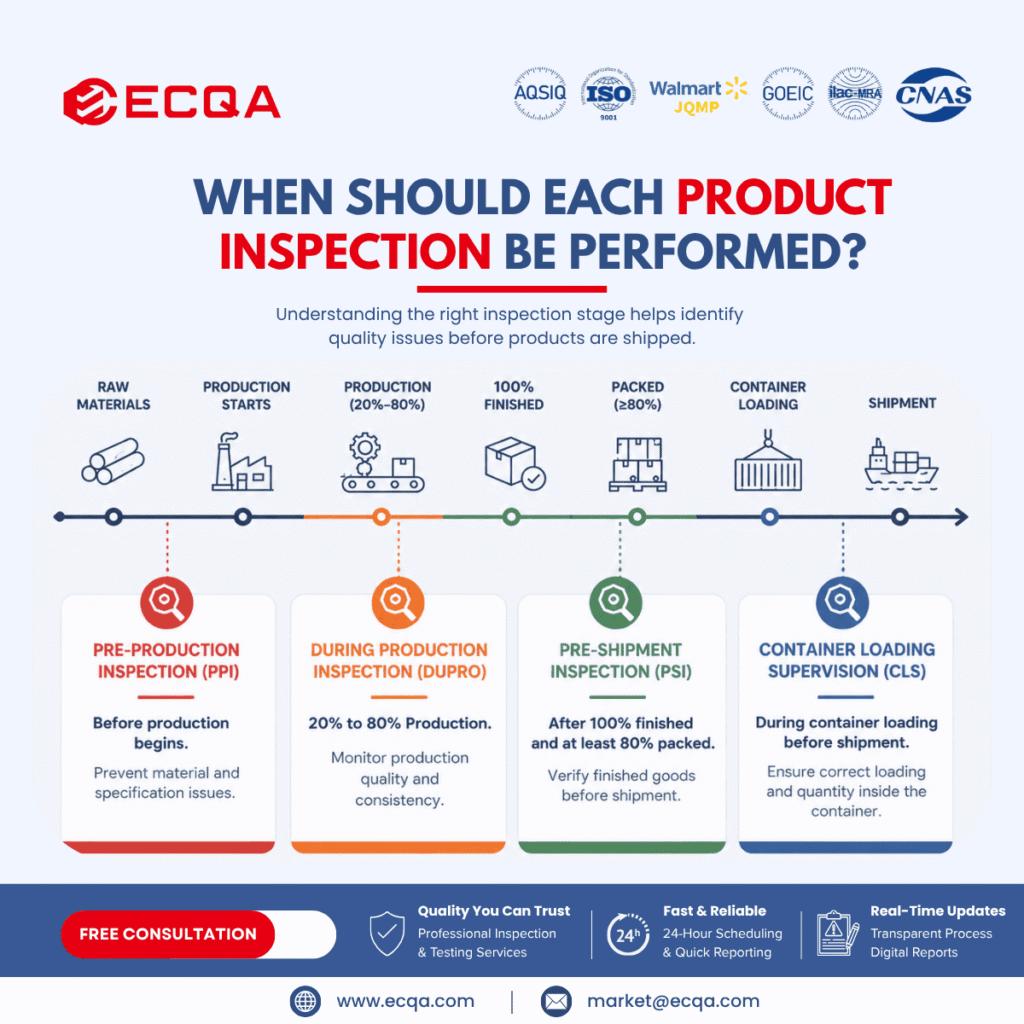
| Inspection Service | When It Is Performed | Primary Purpose |
| Pre-Production Inspection (PPI) | Before production begins | Verify raw materials, components, and production readiness |
| During Production Inspection (DUPRO) | Approximately 20%–80% of production completed | Monitor production quality and identify defects early |
| Pre-Shipment Inspection (PSI) | Production complete and at least 80% packed | Verify finished products before shipment |
| Container Loading Supervision (CLS) | During container loading | Verify loading accuracy, carton quantity, and container condition |
Pre-Production Inspection (PPI)
Pre-Production Inspection is conducted before manufacturing begins to verify that the factory is prepared for production.
Inspectors typically examine:
- Raw materials
- Components
- Packaging materials
- Approved production samples
- Manufacturing equipment
- Production schedules
- Factory readiness
Identifying issues before mass production helps prevent quality problems from affecting the entire production run.
During Production Inspection (DUPRO)
During Production Inspection is generally performed when approximately 20% to 80% of production has been completed.
This inspection focuses on monitoring production quality while corrective actions can still be implemented.
Typical inspection activities include:
- Product workmanship
- Production consistency
- Assembly quality
- Product dimensions
- Functional checks
- Production progress
- Packaging preparation
By identifying defects during manufacturing rather than after production is completed, businesses can reduce rework costs and improve overall product quality.
Pre-Shipment Inspection (PSI)
Pre-Shipment Inspection is the most widely requested inspection service in China and is commonly performed when:
- Production is 100% complete
- At least 80% of products are packed for shipment
Inspectors typically verify:
- Product appearance
- Workmanship quality
- Measurements
- Functional performance
- Product quantity
- Packaging quality
- Label accuracy
- Carton markings
- Shipping marks
- AQL random sampling results
The inspection helps determine whether the shipment complies with buyer specifications before export, allowing corrective actions to be taken if necessary.
Container Loading Supervision (CLS)
Container Loading Supervision is performed while products are being loaded into the shipping container.
The inspection helps verify that the correct products are loaded safely and according to shipment requirements.
Inspectors typically verify:
- Product quantity
- Carton quantity
- SKU accuracy
- Container cleanliness
- Container condition
- Loading procedures
- Cargo handling
- Container seal number
Container Loading Supervision helps reduce the risk of incorrect shipments, damaged goods during loading, and missing cartons.
Industries That Commonly Use Inspection Services in China
Inspection services are used across a wide range of manufacturing industries to verify product quality before shipment. Inspection requirements may vary depending on the product type, applicable standards, customer specifications, and destination market.
Common industries that rely on third-party inspection services include:
- Consumer electronics
- Furniture
- Apparel and textiles
- Footwear
- Toys and children’s products
- Home appliances
- Food packaging
- Plastic products
- Metal products
- Promotional products
- Building materials
- Automotive components
- Industrial equipment
- Medical devices
- Household products
Each industry may require different inspection criteria, functional testing, measurement verification, and regulatory compliance checks depending on the product’s intended use.
Inspection Standards Used in China
Third-party inspections are typically conducted according to internationally recognized quality inspection standards and customer specifications.
AQL Sampling Standards
Most product inspections use Acceptance Quality Limit (AQL) sampling to determine whether a shipment meets the agreed quality level.
Common sampling standards include:
- ISO 2859-1
- ANSI/ASQ Z1.4
Products are randomly selected according to the sampling plan and evaluated against established defect classifications.
Defects are generally categorized as:
| Defect Classification | Description |
| Critical Defects | Defects that may create safety risks or violate regulatory requirements. |
| Major Defects | Defects that affect product function, performance, or customer acceptance. |
| Minor Defects | Cosmetic imperfections that do not significantly affect product usability. |
Using AQL sampling provides an objective and consistent inspection method for evaluating shipment quality.
Product Standards and Customer Requirements
Depending on the product category, inspections may also reference applicable technical standards, including:
- ISO standards
- ASTM standards
- IEC standards
- EN standards
- GB standards
- Customer specifications
- Approved reference samples
The applicable standards vary according to the destination market, product category, and buyer requirements.
How to Choose an Inspection Company in China
Selecting the right inspection company is an important part of supplier quality management. While many inspection providers offer similar services, experience, inspection procedures, reporting quality, and response times can vary considerably.
When choosing a third-party inspection company, consider the following factors:
Industry Experience
Choose an inspection company with experience inspecting products similar to yours. Different industries require different inspection methods, acceptance criteria, and technical knowledge.
Inspection Coverage
A reliable inspection company should be able to provide services across major manufacturing regions in China, allowing inspections to be scheduled quickly regardless of factory location.
Qualified Inspectors
Experienced inspectors should understand applicable inspection procedures, AQL sampling methods, customer specifications, and industry requirements.
Detailed Inspection Reports
Inspection reports should include clear photographs, measurements, defect descriptions, quantity verification, inspection findings, and an overall conclusion to support shipment decisions.
Fast Scheduling and Report Delivery
Production schedules can change quickly. An inspection company should be able to arrange inspections efficiently and provide reports shortly after the inspection is completed.
Additional Quality Services
Many businesses benefit from working with an inspection partner that also offers services such as:
- Factory audits
- Supplier audits
- Product testing coordination
- Defect sorting
- Re-inspection
- Container loading supervision
Using a single quality partner can simplify quality management throughout the supply chain.
Inspection Coverage Across China
China’s manufacturing industry is concentrated across several major production regions. Selecting an inspection company with nationwide coverage helps ensure inspections can be arranged wherever production takes place.
ECQA provides inspection services across major manufacturing cities and industrial regions, including:
- Shenzhen
- Dongguan
- Guangzhou
- Foshan
- Zhongshan
- Ningbo
- Yiwu
- Shanghai
- Suzhou
- Hangzhou
- Qingdao
- Xiamen
- Tianjin
- Chengdu
- Chongqing
Our inspection network supports manufacturers and exporters across China, helping businesses maintain consistent quality regardless of factory location.
Sample Inspection Services
Sample inspections are commonly performed before placing large production orders or approving a new supplier.
A sample inspection allows buyers to evaluate whether a product meets quality expectations before committing to mass production.
Typical sample inspections include verification of:
- Product appearance
- Material quality
- Product dimensions
- Construction and workmanship
- Functional performance
- Packaging
- Labeling
- Applicable compliance requirements
Conducting a sample inspection early in the sourcing process can help identify quality concerns before production begins.
Defect Sorting and Rework Supervision
When quality issues are identified during production or inspection, additional quality control services may be required before shipment.
Common corrective services include:
- Product sorting
- Defect segregation
- Re-inspection
- Repair supervision
- Repackaging
- Carton rework
- Label replacement
These services help prevent non-conforming products from being shipped and reduce the financial impact of quality issues.
By identifying and separating defective products before export, businesses can improve shipment quality while minimizing delays and unnecessary product losses.
What Happens During a Third-Party Inspection?
Although inspection procedures may vary depending on the product type and customer requirements, most third-party inspections follow a structured process to ensure products are evaluated consistently and objectively.
Step 1: Inspection Booking
The inspection is scheduled once the buyer or supplier confirms the production status and factory information.
Typical booking information includes:
- Factory address
- Product details
- Purchase order quantity
- Inspection type
- Preferred inspection date
- Product specifications
Step 2: Factory Coordination
The inspection company contacts the factory to confirm production status, inspection schedule, and product availability.
For pre-shipment inspections, production should normally be 100% complete, with at least 80% of the shipment packed before the inspection begins.
Step 3: Random Sampling
Inspectors randomly select products according to the agreed sampling plan, typically based on ISO 2859-1 or ANSI/ASQ Z1.4.
Random sampling helps provide an objective representation of the overall shipment without inspecting every individual product.
Step 4: Product Inspection
Selected samples are inspected according to the inspection checklist and customer requirements.
Depending on the product, inspection activities may include:
- Product appearance
- Workmanship
- Dimensions and measurements
- Functional testing
- Quantity verification
- Packaging inspection
- Label verification
- Carton inspection
- Barcode verification
- Shipping mark verification
Step 5: Defect Classification
Any issues identified during the inspection are classified according to established defect criteria.
Defects are generally categorized as:
- Critical Defects
- Major Defects
- Minor Defects
The inspection results are then evaluated against the agreed AQL acceptance criteria to determine whether the shipment meets the required quality level.
Step 6: Inspection Report
After the inspection is completed, a detailed inspection report is prepared.
A typical report includes:
- Inspection summary
- Product information
- Quantity verification
- Sampling information
- Product photographs
- Defect photographs
- Measurement results
- Functional test results
- Packaging assessment
- Inspection conclusion
The report provides buyers with the information needed to determine whether the shipment is ready for export or if corrective actions are required.
Benefits of Third-Party Inspection Services in China
Independent inspection services provide an additional layer of quality assurance throughout the manufacturing process.
Some of the key benefits include:
Improve Product Quality
Inspection helps identify defects before shipment, allowing corrective actions to be taken before products reach customers.
Reduce Financial Risk
Detecting quality issues before export can reduce costly returns, product replacements, warranty claims, and shipment delays.
Improve Supplier Accountability
Independent inspections encourage suppliers to maintain consistent production standards and follow agreed specifications.
Increase Supply Chain Visibility
Inspection reports provide buyers with objective information about production quality, shipment readiness, and factory performance.
Support Regulatory Compliance
Inspection helps verify that products, labeling, and packaging comply with customer requirements and applicable regulatory standards before shipment.
Why Choose ECQA Inspection Services in China?
ECQA provides independent third-party inspection services to support businesses sourcing products from manufacturers throughout China.
Our inspection services include:
- Pre-Production Inspection (PPI)
- During Production Inspection (DUPRO)
- Pre-Shipment Inspection (PSI)
- Container Loading Supervision (CLS)
- Sample Inspection
- Factory Audits
- Supplier Audits
- Product Testing Coordination
- Defect Sorting and Rework Supervision
Every inspection is performed using standardized inspection procedures and internationally recognized sampling methods. Detailed inspection reports include photographs, measurements, defect records, and inspection conclusions, enabling buyers to make informed shipment decisions.
With inspection coverage across China’s major manufacturing regions, ECQA helps businesses improve product quality, reduce sourcing risks, and maintain greater visibility throughout the production process.
Inspection services in China play an important role in helping businesses manage product quality throughout the sourcing process. By verifying product quality before shipment, independent inspections reduce quality risks, improve supplier accountability, and provide greater confidence that products meet agreed specifications.
Frequently Asked Questions
1. What is a third-party inspection company?
A third-party inspection company is an independent organization that verifies product quality and compliance on behalf of buyers.
2. When should I conduct a pre-shipment inspection?
A pre-shipment inspection is usually conducted when production is complete and at least 80% of the goods are packed.
3. What is the purpose of AQL inspection?
AQL inspection helps determine whether a shipment meets acceptable quality levels based on statistical sampling methods.
4. Can inspections be conducted anywhere in China?
Yes. Many inspection companies provide nationwide coverage across major manufacturing regions in China.
5. Why do importers use inspection services in China?
Inspection services help buyers reduce quality risks, verify supplier performance, and avoid costly problems after shipment.
6. What happens if an inspection fails?
If inspection results do not meet the agreed acceptance criteria, buyers may request corrective actions such as product rework, defect sorting, replacement of defective products, or a follow-up re-inspection before shipment.

 Request Free Sample Report