

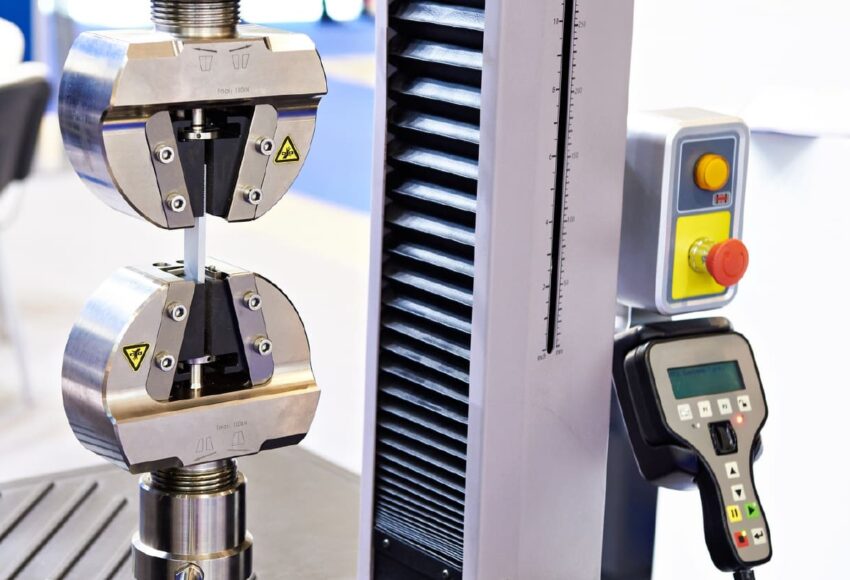
Tensile Strength Testing Explained: Methods, Standards, and Applications
Tensile strength testing is one of the most widely used mechanical tests for evaluating material performance. The test measures how a material responds when subjected to a controlled pulling force until deformation and eventual fracture occur.
By analyzing a material’s behavior under tension, tensile strength testing provides valuable information about strength, ductility, stiffness, and overall structural performance. These properties help manufacturers, engineers, and quality teams determine whether a material is suitable for its intended application.
Because tensile testing provides measurable and repeatable results, it is commonly used for material qualification, product development, supplier verification, quality control, and compliance testing across global manufacturing industries.
Why Tensile Strength Testing Matters
Mechanical performance is critical for products that experience loads during manufacturing, transportation, installation, or normal service conditions.
Tensile strength testing helps verify that materials can withstand these loads without excessive deformation or failure.
Common objectives include:
- Material qualification
- Product development
- Supplier evaluation
- Production quality control
- Compliance verification
- Failure investigation
- Material comparison
The results provide objective data that supports engineering decisions and helps reduce the risk of product failure.
How Tensile Strength Testing Works
Tensile testing is performed using a Universal Testing Machine (UTM), which applies a controlled pulling force to a test specimen until it deforms and eventually fractures.
Step 1: Sample Preparation
A standardized test specimen is prepared according to the applicable testing standard to ensure consistent and reliable results.
Step 2: Specimen Installation
The specimen is secured in the testing machine and aligned properly to ensure the load is applied evenly.
Step 3: Application of Tensile Force
The machine gradually applies tensile force, causing the specimen to stretch under controlled conditions.
Step 4: Measurement of Deformation
Load and elongation are continuously recorded to generate a stress-strain curve and evaluate material performance.
Step 5: Fracture and Analysis
The test continues until the specimen fractures. The recorded data is then used to calculate key mechanical properties such as yield strength, tensile strength, and elongation.
What Does Tensile Strength Testing Measure
Tensile strength testing evaluates how a material behaves under a controlled tensile load. The test provides several key mechanical properties that help assess material strength, ductility, stiffness, and overall performance. These properties are commonly used for material selection, quality control, and compliance verification.
| Property | Description |
| Ultimate Tensile Strength (UTS) | The maximum stress a material can withstand before fracture occurs. |
| Yield Strength | The stress level at which permanent deformation begins. |
| Elongation at Break | The amount a material stretches before failure, indicating ductility. |
| Reduction of Area | The decrease in cross-sectional area at the fracture location, reflecting deformation behavior. |
| Modulus of Elasticity | Also known as Young’s Modulus, this property measures a material’s resistance to elastic deformation and indicates stiffness. |
Common Tensile Strength Testing Standards
Several internationally recognized standards govern tensile testing procedures.
ASTM E8/E8M
ASTM E8/E8M is one of the most widely used standards for tensile testing of metallic materials.
The standard defines:
- Test specimen geometry
- Testing procedures
- Loading rates
- Yield strength determination
- Tensile strength calculations
- Elongation measurements
ASTM E8/E8M is commonly used throughout North America and international supply chains.
ISO 6892-1
ISO 6892-1 is the international standard for tensile testing of metallic materials at room temperature.
The standard specifies:
- Strain rate control methods
- Specimen preparation
- Mechanical property calculations
- Test procedures
ISO 6892-1 is widely applied across Europe, Asia, and global manufacturing environments.
GB/T 228.1
GB/T 228.1 is the Chinese national standard for tensile testing of metallic materials.
It is technically aligned with ISO 6892-1 and is commonly required for products manufactured and certified within China.
JIS Z 2241
JIS Z 2241 governs tensile testing of metallic materials within Japanese manufacturing and quality systems.
The standard is frequently referenced for products intended for the Japanese market.
Common Materials Tested
Tensile strength testing is applicable to a wide range of metallic materials.
Carbon Steel
Used extensively in:
- Construction
- Manufacturing
- Infrastructure
- Industrial equipment
Alloy Steel
Commonly used for:
- Automotive components
- Machinery parts
- High-strength applications
Stainless Steel
Tensile testing helps verify that corrosion-resistant materials maintain the required mechanical performance.
Aluminum and Aluminum Alloys
Testing supports verification of strength-to-weight performance in lightweight applications.
Copper and Copper Alloys
Often tested where both strength and conductivity are important.
Industry Applications of Tensile Strength Testing
Tensile testing plays an important role across numerous industries.
Automotive Industry
Used to evaluate:
- Structural components
- Fasteners
- Suspension parts
- Safety-related components
Construction Industry
Applied to:
- Structural steel
- Reinforcement materials
- Fabricated metal products
Aerospace Industry
Used for:
- Aircraft structures
- High-performance alloys
- Safety-critical materials
Manufacturing Industry
Supports:
- Material verification
- Supplier qualification
- Production quality control
Metal Fabrication Industry
Helps verify:
- Material consistency
- Mechanical performance
- Compliance with specifications
Factors Affecting Tensile Testing Accuracy
Accurate tensile testing depends on proper control of testing conditions.
Important factors include:
Specimen Preparation
Improper specimen dimensions or surface conditions may affect results.
Machine Calibration
Load cells, extensometers, and testing systems must be calibrated regularly.
Alignment
Misalignment can introduce unintended stresses and influence measurements.
Testing Speed
Incorrect strain rates may alter measured mechanical properties.
Environmental Conditions
Temperature and testing conditions can affect material behavior.
Following recognized standards helps minimize these sources of error.
Tensile Testing in Quality Control
Tensile strength testing is frequently used at multiple stages of the manufacturing process.
Common applications include:
Incoming Material Inspection
Verifies supplier material quality and specification compliance.
Production Monitoring
Detects process variations before products reach customers.
Supplier Qualification
Provides objective data for evaluating material consistency.
Product Certification
Supports technical documentation and regulatory requirements.
Failure Investigation
Helps identify potential causes of material or product failure.
Tensile strength testing is one of the most important methods for evaluating material performance and mechanical reliability. By measuring properties such as yield strength, tensile strength, elongation, and stiffness, the test provides valuable information for product development, quality control, supplier qualification, and compliance verification.
When performed according to recognized standards and controlled testing procedures, tensile testing provides reliable data that supports informed engineering decisions and helps ensure consistent product quality throughout the supply chain.
Frequently Asked Questions
1. What is tensile strength testing used for?
Tensile strength testing is used to evaluate a material’s mechanical performance, including strength, ductility, and resistance to deformation.
2. Is tensile testing destructive?
Yes. The specimen is pulled until fracture occurs, making tensile testing a destructive test method.
3. What is the difference between yield strength and tensile strength?
Yield strength indicates when permanent deformation begins, while tensile strength represents the maximum stress a material can withstand before failure.
4. Which standard is commonly used for tensile testing?
ASTM E8/E8M and ISO 6892-1 are among the most widely used standards for tensile testing of metallic materials.
5. What industries use tensile strength testing?
Common industries include automotive, aerospace, construction, manufacturing, energy, and metal fabrication.

 Request Free Sample Report