

Polymer Tensile Testing: Methods, Standards & Strength
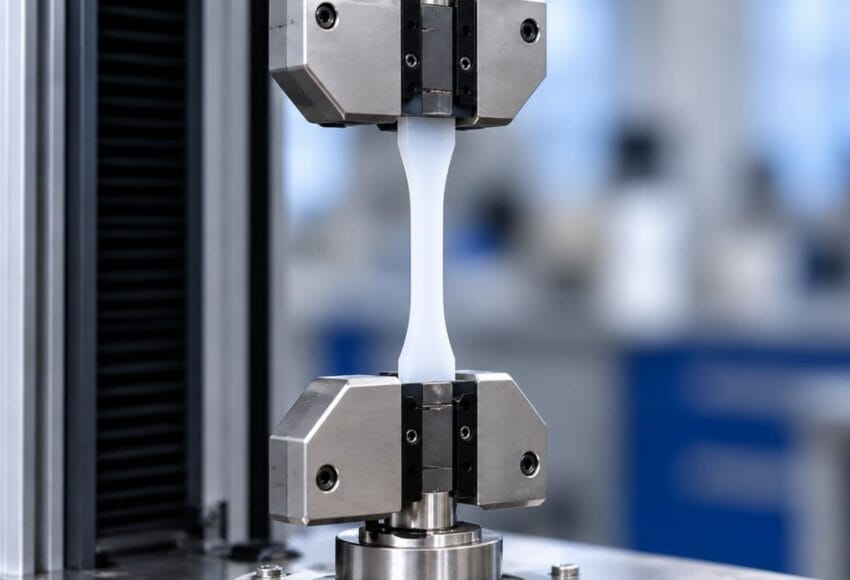
Polymer tensile testing measures how a polymer material behaves when subjected to a controlled tensile force. During the test, a prepared specimen is held in a tensile testing machine and pulled at a specified rate while force and deformation are measured.
Depending on the material and applicable test method, the test can determine tensile strength, tensile modulus, yield properties, and elongation at break. These results help evaluate whether plastics, rubber, elastomers, films, and other polymer materials meet defined mechanical performance requirements.
Different polymer materials require different test methods. ISO 527 and ASTM D638 are widely used for plastics, while ISO 37 and ASTM D412 cover tensile testing of rubber and thermoplastic elastomers. Thin films and sheets may require standards such as ASTM D882 or ISO 527-3.
What is Polymer Tensile Testing?
Polymer tensile testing evaluates the stress-strain behavior of a polymer under tensile loading.
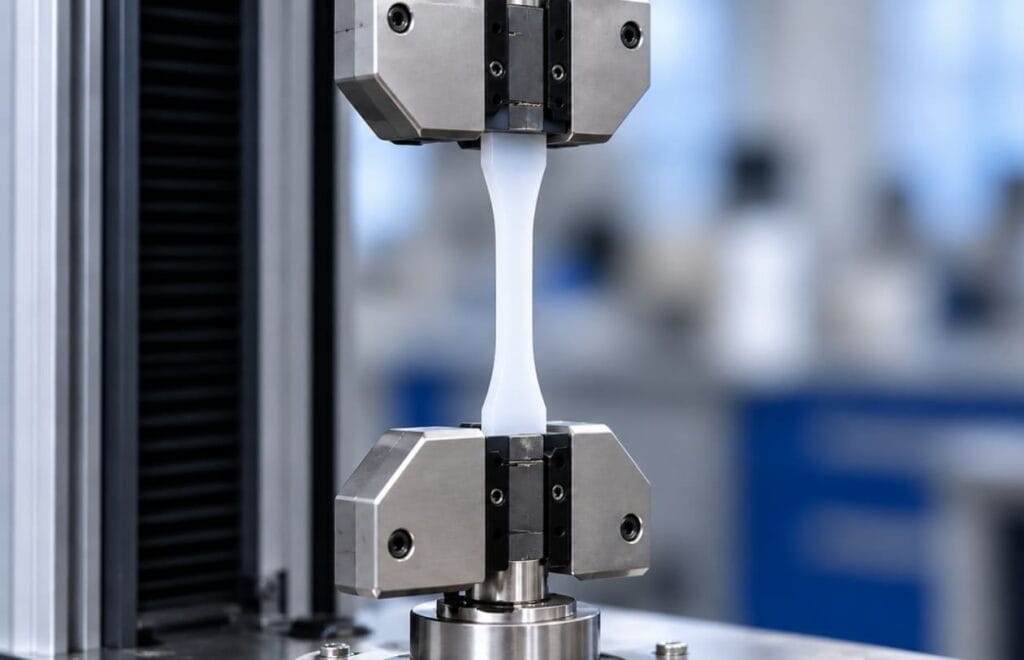
A test specimen is mounted between the grips of a tensile testing machine. The grips move apart at a controlled speed, gradually stretching the specimen while the equipment records the applied force and resulting deformation.
The measured data can be used to calculate mechanical properties such as:
- Tensile strength
- Tensile modulus
- Yield stress
- Elongation at yield
- Elongation at break
The appropriate properties depend on the material and applicable standard. A rigid engineering plastic, flexible packaging film, and thermoplastic elastomer can behave very differently when pulled, so the same testing conditions cannot automatically be applied to every polymer.
What Properties Does a Polymer Tensile Test Measure?
A tensile test provides information about how a polymer responds as tensile load increases. Several properties may be determined from the resulting stress-strain data.
Tensile Strength
Tensile strength describes the tensile stress associated with a defined point during the test, commonly the maximum tensile stress reached under the applicable method.
It is generally expressed in megapascals (MPa) or N/mm².
Tensile strength is frequently used to compare material batches or verify whether a polymer meets a specified mechanical requirement.
Tensile Modulus
Tensile modulus describes material stiffness based on the relationship between stress and strain within the region defined by the applicable test method.
A higher tensile modulus generally indicates a stiffer material, while a lower modulus indicates greater flexibility under tensile loading.
Tensile modulus and tensile strength describe different characteristics. A polymer may be relatively stiff without having the highest tensile strength.
Yield Strength
Some polymers reach a point where significant deformation begins during tensile loading.
Where the material exhibits suitable yield behavior, the corresponding stress may be reported as yield stress or yield strength according to the applicable standard.
Not every polymer has a clearly defined yield point.
Elongation at Break
Elongation at break describes how much the specimen has extended when rupture occurs and is generally expressed as a percentage.
This property can be particularly useful when evaluating flexible plastics and elastomers.
A material with high elongation at break can undergo substantial deformation before rupture, while a brittle material may break after relatively little elongation.
How is Polymer Tensile Testing Performed?
The exact polymer tensile testing procedure depends on the material, specimen form, required property, and applicable standard. A typical test involves the following stages.
1. Select the Applicable Test Standard
The first step is to determine which standard applies to the material.
Common examples include:
| Material | Common Test Standards |
| Plastics | ISO 527, ASTM D638 |
| Vulcanized and thermoplastic rubber | ISO 37 |
| Vulcanized rubber and thermoplastic elastomers | ASTM D412 |
| Thin plastic films and sheets | ISO 527-3, ASTM D882 |
| Fibre-reinforced polymer composites | Applicable composite-specific tensile standards |
The material form is important when selecting the method. For example, ASTM D638 is commonly used for plastic specimens, while ASTM D882 is designed for tensile properties of thin plastic sheeting and film.
2. Prepare and Condition the Specimens
Polymer tensile specimens must be prepared according to the geometry specified by the applicable standard.
For many plastic and rubber tests, specimens have a dumbbell or dog-bone shape with a narrower central test section.
Depending on the material and standard, specimens may be:
- Injection molded
- Compression molded
- Machined
- Die cut
- Cut from sheets or finished products
Specimen preparation can directly affect the result. Rough edges, scratches, notches, incorrect dimensions, or damage introduced during cutting can create stress concentrations and premature failure.
Polymers can also be sensitive to temperature and moisture. Where required, specimens are conditioned under specified environmental conditions before testing.
3. Measure and Mount the Specimen
Relevant specimen dimensions, such as width and thickness, are measured according to the applicable test method.
Accurate dimensional measurements are important because tensile stress calculations depend on the original cross-sectional dimensions of the specimen.
The specimen is then positioned between the grips of a tensile testing machine or universal testing machine.
Correct alignment helps ensure that the force is applied along the intended tensile axis. The grips must hold the specimen securely without excessive slipping or introducing premature damage.
4. Apply the Tensile Load
The machine separates the grips at the test speed specified by the applicable standard.
As the specimen stretches, the system records force and deformation. An extensometer or other suitable strain-measurement system may be used when accurate strain measurement is required.
The test continues until the specified endpoint is reached, which may include yielding, a defined strain, maximum tensile stress, or specimen rupture.
5. Calculate and Report the Results
The measured force and deformation data are evaluated according to the selected test method.
Depending on the test requirements, the reported results may include:
- Tensile strength
- Tensile modulus
- Yield stress
- Elongation at yield
- Elongation at break
- Stress at a specified strain
- Failure observations
The applicable standard and test conditions should be clearly identified when reporting the results.
Polymer Tensile Testing Standards
There is no single tensile test standard that covers every polymer material. The correct standard depends on material type, thickness, specimen form, and the required tensile property.
ISO 527 for Plastics
ISO 527 is an international standard series for determining the tensile properties of plastics.
ISO 527-1:2019 establishes the general principles for determining tensile properties. The series includes additional parts covering specific types of specimens and materials.
Important parts include:
- ISO 527-1: General principles
- ISO 527-2: Test conditions for molding and extrusion plastics
- ISO 527-3: Test conditions for films and sheets
- ISO 527-4: Test conditions for isotropic and orthotropic fibre-reinforced plastic composites
- ISO 527-5: Test conditions for unidirectional fibre-reinforced plastic composites
The applicable part should be selected according to the material being evaluated.
ASTM D638 for Plastics
ASTM D638 is widely used to determine the tensile properties of plastics.
The test uses standardized specimens and defined testing conditions to determine properties such as tensile strength, yield behavior, tensile modulus, and elongation.
ASTM D638 is applicable to many unreinforced and reinforced plastic materials. The standard covers materials up to the thickness specified within its scope.
For thin plastic sheeting and films, a film-specific tensile method such as ASTM D882 may be more appropriate.
ISO 37 and ASTM D412 for Rubber and Elastomers
Rubber and elastomer materials require tensile methods suited to their greater deformation characteristics.
ISO 37 covers the determination of tensile stress-strain properties of vulcanized and thermoplastic rubber. Depending on the material and test requirements, properties may include tensile strength, elongation at break, stress at a specified elongation, and yield properties.
ASTM D412 covers tension testing of vulcanized thermoset rubber and thermoplastic elastomers.
ASTM D412 includes methods using dumbbell, straight-section, and cut-ring specimens as applicable. Results obtained from different specimen configurations should be interpreted according to the specified method.
Tensile Testing for Plastic Films and Sheets
Thin films can behave differently from thicker molded plastic specimens and may require dedicated test procedures.
ISO 527-3 provides tensile test conditions for plastic films and sheets, while ASTM D882 is commonly used for thin plastic sheeting.
These methods may be relevant to materials such as:
- Polyethylene film
- Polypropylene film
- Flexible packaging film
- Plastic bags
- Thin polymer sheets
The direction of testing can also be important. Manufacturing processes can create different tensile properties in the machine direction (MD) and transverse direction (TD).
Where applicable, specimens should therefore be prepared and tested in the specified orientation.
ISO 527 vs ASTM D638
ISO 527 and ASTM D638 both address tensile testing of plastics, but their procedures are not identical.
| Item | ISO 527 | ASTM D638 |
| Main application | Tensile properties of plastics | Tensile properties of plastics |
| Structure | Multi-part standard series | Primary ASTM test method |
| Tensile strength | Yes | Yes |
| Tensile modulus | Yes | Yes |
| Yield properties | Where applicable | Where applicable |
| Elongation | Yes | Yes |
| Film testing | ISO 527-3 | ASTM D882 generally used for thin film |
Differences can exist in areas such as specimen geometry, test speed, strain measurement, conditioning, and calculation procedures.
Results obtained according to ISO 527 should therefore not automatically be treated as equivalent to ASTM D638 results.
When a product specification, material specification, drawing, or customer requirement identifies a particular standard, the specified method should be followed.
Factors That Affect Polymer Tensile Test Results
Polymer tensile properties are sensitive to both material characteristics and testing conditions. Consistent test conditions are important when comparing different materials or production batches.
Specimen Geometry
Specimen width, thickness, gauge length, and shape affect the stress distribution during testing.
Using different specimen geometries can produce different results, even when the specimens are made from the same material.
Test Speed
Polymers can be sensitive to strain rate.
Changes in testing speed may influence tensile strength, yield behavior, elongation, and other measured properties. The speed should therefore follow the applicable standard.
Temperature and Humidity
Polymer mechanical properties can change with environmental conditions.
Some plastics become more flexible as temperature increases, while lower temperatures may increase brittle behavior. Moisture absorption can also affect certain polymer materials.
Specified conditioning and testing conditions should be controlled when required.
Specimen Preparation
Poorly prepared specimens can cause premature failure.
Common preparation problems include:
- Rough edges
- Scratches
- Notches
- Uneven thickness
- Incorrect dimensions
- Damage caused during cutting or machining
Consistent specimen preparation helps reduce unnecessary test variation.
Grip and Alignment
Improper gripping can cause the specimen to slip or fail near the grip.
Misalignment may introduce bending or uneven stress instead of a controlled tensile load.
Failure location and specimen condition should therefore be considered when evaluating whether a test result is valid.
How to Interpret Polymer Tensile Test Results
Polymer tensile results should be evaluated against the applicable material specification, product requirement, approved reference, or defined acceptance criteria.
A lower-than-required tensile strength can be associated with changes in material formulation, degradation, contamination, processing conditions, voids, or other material inconsistencies. The tensile result identifies the measured mechanical performance, while additional investigation may be needed to determine the root cause.
Unexpectedly low elongation at break may indicate that the material is behaving more brittly than expected.
Large differences between replicate specimens can also require further review. Possible factors include material inconsistency, specimen preparation, dimensional variation, gripping, alignment, conditioning, or test execution.
A higher tensile strength should not automatically be interpreted as better material quality. Required performance depends on the intended material specification. Flexible components, rigid plastic housings, packaging films, and elastomers can require very different combinations of strength, stiffness, and elongation.
How to Specify Polymer Tensile Testing Requirements
A request that states only perform tensile testing may leave important test conditions undefined.
Clear test requirements should identify the material, standard, required properties, and acceptance criteria.
| Requirement | Example |
| Material | ABS, PP, PE, TPE, vulcanized rubber |
| Test standard | ISO 527, ASTM D638, ISO 37, ASTM D412 |
| Applicable standard part | Where required |
| Specimen type | According to specified standard |
| Test direction | MD / TD where applicable |
| Conditioning | According to standard or specification |
| Required properties | Tensile strength, modulus, elongation |
| Acceptance criteria | Defined specification limits |
| Number of specimens | According to applicable method or specification |
These requirements should be established before testing so that the laboratory can select the correct procedure and the resulting data can be evaluated consistently.
Reliable polymer tensile testing requires the correct standard, representative specimens, controlled test conditions, and clearly defined acceptance criteria. The test method should be selected according to the polymer type and specimen form, with results evaluated against the applicable material or product specification.

 Request Free Sample Report