

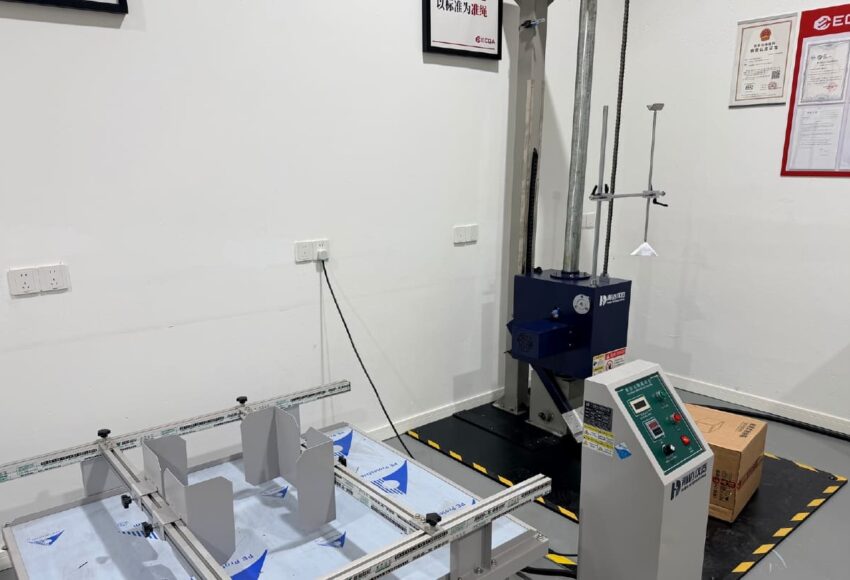
ISTA 3A Testing: Procedure, Requirements and Packaging Test Certificate
ISTA 3A testing is a general simulation performance test for individual packaged products weighing 150 lb (70 kg) or less and shipped through parcel delivery systems. The procedure evaluates how a product and its packaging respond to defined transportation and handling hazards under controlled laboratory conditions.
Developed by the International Safe Transit Association (ISTA), Procedure 3A belongs to the 3 Series General Simulation Performance Tests. It is designed for packaged products distributed individually through parcel networks, including ground and air transportation.
ISTA 3A covers four package types: Standard, Small, Flat, and Elongated. The applicable test sequence depends on the package classification and may include atmospheric conditioning, drop testing, random vibration, rotational impacts, and specialized impact tests.
The procedure evaluates the complete packaged product, including the outer packaging, cushioning materials, internal supports, closures, and the product itself.
Before testing, the shipper must establish acceptable product damage and packaging degradation criteria. The final results are evaluated against these criteria.
What is ISTA 3A Testing?
ISTA 3A is a packaging performance test developed to evaluate individual packaged products exposed to hazards associated with parcel distribution.
Parcel delivery systems involve multiple handling and transportation activities. Packages may pass through sorting facilities, conveyor systems, loading operations, delivery vehicles, and distribution centers before reaching their destinations.
These activities can expose packages to:
- Repeated handling impacts
- Drops during loading and unloading
- Vibration during transportation
- Forces from packages stacked together
- Contact with other parcels
- Changes in package orientation
- Atmospheric conditions that affect packaging materials
ISTA 3A uses a defined laboratory test sequence to evaluate packaged-product performance against selected distribution hazards.
The procedure is commonly used for:
- Evaluating packaging designs intended for parcel shipment
- Assessing protective packaging performance
- Comparing alternative cushioning materials
- Identifying weaknesses in cartons and internal packaging
- Investigating shipping damage
- Evaluating packaging changes
- Supporting packaging qualification requirements
- Establishing consistent packaging performance criteria
The test result applies to the packaged-product configuration evaluated, including its dimensions, materials, weight, cushioning, and packing arrangement.
What Products Are Covered by ISTA 3A?
ISTA 3A applies to individual packaged products weighing 150 lb (70 kg) or less when prepared for shipment through a parcel delivery system.
The weight includes the product and its complete shipping packaging.
Examples of products that may be evaluated include:
- Consumer electronics
- Small household appliances
- Kitchen appliances
- Toys and games
- Home accessories
- Household goods
- Personal care products
- Automotive components
- Hardware products
- Small furniture components
- Industrial parts
- Retail and e-commerce products
Product type alone does not determine whether ISTA 3A is appropriate.
The packaging configuration, distribution method, packaged-product weight, and testing objective must also be considered.
For example, a small appliance shipped individually in a corrugated carton through a parcel carrier may be suitable for ISTA 3A.
The same appliance shipped as part of a palletized distribution load may require evaluation under another procedure appropriate to that distribution system.
ISTA 3A Package Types: Standard, Small, Flat and Elongated
ISTA 3A classifies packaged products into four categories based on package dimensions and configuration.
This classification is important because different package shapes may experience different handling and impact hazards during parcel distribution.
Standard Packaged Products
A Standard packaged product is a package that does not meet the definitions for Small, Flat, or Elongated packages.
Examples may include:
- Conventional corrugated shipping cartons
- Boxed household appliances
- Packaged consumer electronics
- Plastic shipping containers
- Certain cylindrical containers
- Wooden shipping packages
Standard packages are evaluated using the test sequence applicable to their classification.
Small Packaged Products
Small packaged products are defined using specific dimensional and weight criteria established by ISTA.
These packages may be exposed to handling conditions that differ from those experienced by larger parcels.
Examples can include:
- Small accessory packages
- Compact electronic products
- Small retail cartons
- Lightweight packaged components
The package must satisfy the applicable dimensional and weight requirements to qualify as Small.
The current ISTA 3A procedure should be used to determine the classification.
Flat Packaged Products
Flat packaged products have a relatively thin profile compared with their other dimensions.
Examples may include:
- Flat-packed home accessories
- Picture frames
- Certain furniture panels
- Thin rectangular products
- Large flat retail packages
ISTA 3A includes additional impact evaluations for Flat packages because their shape can make them vulnerable to bending, edge impacts, and concentrated forces.
Elongated Packaged Products
Elongated packaged products have a long, narrow configuration.
Under the published ISTA 3A classification, an Elongated package has a longest dimension of at least 900 mm (36 inches), with each of the other two dimensions measuring no more than 20% of the longest dimension.
Examples may include:
- Long hardware components
- Curtain rods
- Narrow metal profiles
- Long tubular products
- Certain lighting products
- Packaged rails or similar components
Elongated packages may experience bending and localized impacts during transportation.
The procedure therefore includes additional evaluations for this package type.
Where a packaged product satisfies both the Flat and Elongated definitions, ISTA specifies classification as Elongated.
ISTA 3A Package Classification Summary
| Package Type | General Characteristics | Examples |
| Standard | Does not qualify as Small, Flat, or Elongated | Conventional shipping cartons |
| Small | Meets specified small-package dimensions and weight criteria | Compact accessories and retail goods |
| Flat | Wide, relatively thin package meeting defined dimensional criteria | Frames and flat-packed products |
| Elongated | Long, narrow package meeting defined dimensional criteria | Rods, rails, and tubular products |
The exact classification should be confirmed using the current applicable ISTA 3A procedure.
ISTA 3A Test Sequence
The ISTA 3A test sequence is designed to evaluate the packaged product under defined conditions associated with parcel transportation and handling.
The applicable sequence varies according to the package classification.
Testing may include the following elements:
- Atmospheric preconditioning
- Controlled atmospheric conditioning, where specified
- Initial drop testing
- Random vibration testing
- Random vibration under low pressure, where applicable
- Additional drop testing
- Rotational edge drop testing for specified package types
- Full rotational flat drop testing for specified package types
- Concentrated impact testing for Flat packages
- Bridge impact testing for Elongated packages
- Leak testing where applicable
The exact sequence, test levels, and required or optional elements must follow the applicable edition of ISTA 3A.
Atmospheric Preconditioning
Atmospheric preconditioning prepares the packaged product for mechanical testing.
Packaging materials may respond differently to changes in temperature and humidity.
For example:
- Corrugated board may lose strength when exposed to high humidity.
- Adhesives may respond differently to temperature changes.
- Certain cushioning materials may become more rigid or flexible.
- Packaging components may expand or contract.
Preconditioning helps establish the required starting condition before the mechanical test sequence begins.
Controlled Atmospheric Conditioning
Controlled temperature and humidity conditioning may be included where specified by the testing program.
The selected conditions can be used to evaluate packaging exposed to particular atmospheric environments.
These conditions may be relevant when packaging materials are sensitive to moisture or temperature.
The applicable conditioning profile and duration should be established according to the current procedure and testing requirements.
ISTA 3A Drop Testing
Drop testing evaluates the ability of the packaged product to withstand impacts associated with handling.
During parcel distribution, packages may be dropped while being transferred between handling equipment, sorting systems, and delivery vehicles.
ISTA 3A uses defined drop sequences that challenge different areas of the package.
Depending on the package classification, these may include impacts involving:
- Corners
- Edges
- Faces
- Specified package orientations
- Additional hazard-related impacts
The drop height and sequence depend on the applicable test requirements and packaged-product characteristics.
Drop testing can reveal:
- Insufficient cushioning
- Product movement inside the package
- Corner damage
- Carton deformation
- Closure failure
- Product cracking or breakage
- Displacement of internal supports
- Damage to fragile components
The condition of the product and packaging should be evaluated after the applicable test sequence.
ISTA 3A Random Vibration Testing
Random vibration testing evaluates how the packaged product responds to repeated vibration associated with transportation.
Parcel shipments may experience vibration from road surfaces, vehicle suspension, handling equipment, and other transportation conditions.
ISTA 3A uses random vibration profiles intended to represent selected transportation hazards.
The procedure includes vibration evaluations with and without top loading, as applicable.
Random vibration with top load evaluates package performance while a specified load is applied above the packaged product.
Random vibration without top load evaluates the package under the prescribed vibration conditions without that additional load.
Vibration testing can identify:
- Internal product movement
- Cushioning displacement
- Abrasion
- Loose components
- Packaging fatigue
- Product-to-package contact
- Closure deterioration
- Damage caused by repeated movement
For example, a packaged appliance may remain protected during drop testing but develop surface abrasion when internal cushioning allows repeated movement during vibration.
Both impact resistance and vibration performance are therefore important when evaluating packaging for parcel distribution.
Random Vibration Under Low Pressure
ISTA 3A includes an optional test involving random vibration under reduced atmospheric pressure.
This test is particularly relevant to evaluating the integrity of sealed packaging where changes in atmospheric pressure may affect closures or content retention.
Potential applications include packages containing:
- Liquids
- Powders
- Gases
- Other products requiring sealed containment
The test can help evaluate whether a container maintains its seal under the prescribed conditions.
The applicability of low-pressure vibration testing should be determined from the product, packaging configuration, distribution requirements, and current procedure.
Rotational Edge Drop Testing
Rotational edge drop testing is used for specified package classifications, including Flat and Elongated packages.
The test evaluates package response when it rotates and impacts a supporting surface.
This type of impact can create localized stresses at edges and corners.
Potential problems include:
- Edge deformation
- Damage to long or thin products
- Internal support failure
- Carton seam separation
- Product displacement
The test conditions and orientations depend on the applicable package classification.
Full Rotational Flat Drop Testing
Full rotational flat drop testing evaluates the effect of a package rotating and falling onto a supporting surface.
This test is particularly relevant to Flat and Elongated packages.
The resulting impact can create bending forces or distribute loads across the packaged product in ways that differ from conventional free-fall drops.
The test may reveal weaknesses in:
- Internal supports
- Product restraint
- Cushioning placement
- Package rigidity
- Structural protection
Concentrated Impact Testing for Flat Packages
Concentrated impact testing evaluates the response of Flat packages to localized impact forces.
A concentrated force can damage a package even when the overall carton structure appears adequate.
For example, a flat-packed product may experience localized pressure or impact that causes cracking, denting, or deformation.
This test helps identify weaknesses associated with the package’s relatively thin profile.
Bridge Impact Testing for Elongated Packages
Bridge impact testing evaluates the response of Elongated packages to a defined impact condition.
Long, narrow packages may be vulnerable to bending when supported at different points.
The test can reveal:
- Product bending
- Structural fracture
- Damage to internal supports
- Insufficient packaging rigidity
- Failure of protective inserts
The test is relevant to products such as long components, rails, rods, and other elongated goods.
Does ISTA 3A Include Compression Testing?
ISTA 3A includes top-load conditions during random vibration testing.
This creates a defined loading condition while the package is exposed to vibration.
The procedure should not automatically be described as requiring a separate static carton compression test.
Where a buyer requires a specific box compression strength, separate compression testing may be necessary.
For example, a packaging specification may require evaluation of corrugated box strength using an applicable compression test method.
The appropriate test depends on whether the objective is to evaluate package performance during parcel distribution or to measure a particular packaging material or structural property.
How Is an ISTA 3A Test Conducted?
ISTA 3A testing begins with identifying the packaged product and establishing the required performance criteria.
1. Identify the Packaged Product
The test sample should represent the actual packaged product intended for distribution.
Relevant information includes:
- Product description
- Product dimensions
- Product weight
- Total packaged-product weight
- Shipping carton dimensions
- Packaging materials
- Cushioning configuration
- Internal supports
- Closure method
- Packing arrangement
- Package classification
These details are important because packaging performance can change when materials, dimensions, or packing configurations are modified.
2. Establish Product Damage and Package Degradation Criteria
Before testing, the shipper should define what constitutes unacceptable product damage and packaging degradation.
Acceptance criteria may include:
- Product functionality
- Structural integrity
- Cosmetic condition
- Component security
- Product deformation
- Carton condition
- Closure integrity
- Cushioning performance
- Internal packaging condition
For example, minor deformation of an outer shipping carton may be acceptable if the product remains protected and the agreed packaging criteria are satisfied.
A package intended for retail presentation may have stricter cosmetic requirements.
The acceptance criteria should be documented before testing.
3. Prepare the Test Sample
The sample should use the actual product and intended shipping packaging wherever possible.
The packaging configuration should include the relevant:
- Outer carton
- Cushioning
- Protective inserts
- Dividers
- Internal supports
- Closures
- Accessories
- Product arrangement
Substituting materials or changing the packing configuration can affect the test result.
4. Confirm the Package Classification
The laboratory determines whether the packaged product qualifies as Standard, Small, Flat, or Elongated.
The classification determines which test sequence and additional evaluations apply.
5. Perform Atmospheric Conditioning
The packaged product undergoes the applicable preconditioning and any specified controlled atmospheric conditioning.
The laboratory records the relevant test conditions.
6. Conduct Shock and Vibration Testing
The packaged product is subjected to the prescribed shock and vibration tests in the required sequence.
Additional tests are performed according to the package classification and applicable testing requirements.
7. Examine the Product and Packaging
After testing, the product and packaging are evaluated against the acceptance criteria.
The assessment may include:
- Visual inspection
- Functional checks
- Product damage evaluation
- Carton condition assessment
- Cushioning inspection
- Closure verification
- Documentation of defects
The laboratory records the observations and test results.
How Many Samples Are Required for ISTA 3A?
A complete ISTA 3A procedure can be performed on one packaged-product sample, subject to the applicable procedure requirements.
However, a single sample provides limited information about variation between production units and packaging configurations.
Additional samples may be appropriate when the testing objective requires greater confidence in packaging performance.
Factors affecting sample quantity include:
- Product variability
- Packaging material consistency
- Customer requirements
- Testing objectives
- Available samples
- Packaging design changes
Each additional test should use a suitable new packaged-product sample.
Previous exposure to vibration or impact can affect packaging condition and influence subsequent test results.
The testing laboratory should confirm the sample requirements before testing begins.
ISTA 3A Test Equipment
The equipment required for ISTA 3A depends on the package classification and applicable test sequence.
Typical equipment may include:
- Random vibration testing equipment
- Controlled drop testing equipment
- Top-loading equipment for vibration testing
- Equipment for rotational drop testing
- Specialized impact testing equipment
- Atmospheric conditioning equipment
- Low-pressure testing equipment where applicable
- Measurement equipment for package dimensions and weight
Equipment must be suitable for the packaged-product dimensions, weight, and required test conditions.
The applicable equipment requirements should be confirmed using the current ISTA 3A procedure.
How Are ISTA 3A Test Results Evaluated?
ISTA 3A results are evaluated against the product damage tolerance and packaging degradation criteria established before testing.
The evaluation considers the condition of the complete packaged product.
Typical assessment areas include:
- Completion of the required test sequence
- Product functionality
- Structural damage
- Cosmetic damage
- Component security
- Packaging deformation
- Cushioning condition
- Closure integrity
- Product movement
- Content retention where applicable
For example, a carton may show visible deformation after impact testing while the product remains functional and undamaged.
The acceptability of that result depends on the predefined criteria.
Similarly, a carton may remain largely intact while the product inside suffers damage from repeated vibration.
The final assessment should reflect the agreed requirements for both product and packaging performance.
What Can Cause a Package to Fail ISTA 3A Testing?
Packaging failures can result from weaknesses in the outer packaging, cushioning system, internal supports, product construction, or packing arrangement.
Insufficient Cushioning
Cushioning materials may provide inadequate protection against repeated impacts.
Potential causes include:
- Insufficient cushioning thickness
- Incorrect cushioning density
- Poor material selection
- Inadequate corner protection
- Incorrect cushioning placement
The cushioning system should be appropriate for the product’s weight, dimensions, and fragility.
Excessive Product Movement
Excessive clearance inside a package can allow the product to move during transportation simulation.
This movement may cause:
- Abrasion
- Scratches
- Component collisions
- Accessory damage
- Contact with the outer carton
- Displacement of protective materials
Internal packaging should maintain the product in its intended position throughout the test sequence.
Weak Carton Construction
The outer carton may deteriorate under repeated handling impacts and vibration.
Potential problems include:
- Panel deformation
- Corner damage
- Seam separation
- Carton tearing
- Insufficient structural rigidity
- Closure failure
Carton construction should correspond with the product weight, dimensions, and distribution requirements.
Inadequate Internal Supports
Foam inserts, molded pulp trays, dividers, and other internal supports help control product movement.
If these components shift, fracture, or collapse, the product may lose protection.
Poor Protection for Flat and Elongated Products
Flat and Elongated packages may require additional structural support because of their geometry.
Potential weaknesses include:
- Insufficient bending resistance
- Poor edge protection
- Inadequate internal reinforcement
- Weak support around fragile areas
- Excessive unsupported product length
The specialized impact tests in ISTA 3A can help identify these problems.
Closure Failure
Tape, adhesive, straps, or other closure systems may loosen during vibration or impact testing.
Closure performance can be affected by:
- Material quality
- Application method
- Carton surface condition
- Environmental exposure
- Package weight
- Handling stresses
Product Design Weaknesses
A packaging failure may also involve weaknesses in the product itself.
Fragile assemblies, loose internal components, and inadequate structural strength can contribute to damage.
The test results should therefore be reviewed in relation to the complete packaged-product system.
What Is an ISTA 3A Test Report or Certificate?
An ISTA 3A test report documents the packaged product, applicable test procedure, test conditions, observations, and results.
Depending on the laboratory and testing program, the report may include:
- Applicant information
- Product identification
- Sample description
- Total packaged-product weight
- Package dimensions
- Package classification
- Packaging configuration
- Applicable ISTA procedure
- Test equipment
- Atmospheric conditioning
- Shock test conditions
- Vibration test conditions
- Additional applicable test conditions
- Product and packaging observations
- Photographic evidence
- Acceptance criteria
- Test results
The report should identify the packaging configuration tested.
ISTA 3A Test Report vs Packaging Test Certificate
A laboratory-issued test report records the testing performed and the observed results.
A packaging test certificate may be requested by a buyer or another party as evidence that testing has been completed.
The meaning of a certificate depends on the issuing organization and applicable testing or certification program.
An ISTA 3A test report does not automatically establish ISTA package certification.
Claims relating to ISTA certification should comply with the requirements of the relevant ISTA certification program.
ISTA 1A vs ISTA 3A
ISTA 1A and ISTA 3A are both used to evaluate packaged-product performance, but they address different testing objectives.
| Requirement | ISTA 1A | ISTA 3A |
| ISTA Series | 1 Series | 3 Series |
| Test classification | Non-simulation integrity | General simulation |
| Packaged-product weight | 150 lb (68 kg) or less | 150 lb (70 kg) or less |
| Main application | Packaging integrity screening | Parcel delivery system shipments |
| Vibration approach | Fixed-displacement vibration | Random vibration |
| Shock testing | Defined shock sequence | Parcel-distribution-oriented shock sequences |
| Package classifications | General packaged products | Standard, Small, Flat, Elongated |
| Additional specialized impacts | Limited to applicable shock methods | Package-specific impact evaluations |
| Distribution focus | General integrity | Parcel distribution |
ISTA 1A is commonly used to evaluate packaging integrity under repeatable laboratory conditions.
ISTA 3A is appropriate when the testing objective involves the selected hazards associated with parcel delivery systems.
The procedures also use different published metric weight descriptions. ISTA identifies Procedure 1A as 150 lb (68 kg) or less and Procedure 3A as 150 lb (70 kg) or less.
For more information about the integrity testing procedure, see our guide to ISTA 1A Testing.
ISTA 2A vs ISTA 3A
ISTA 2A belongs to the 2 Series Partial Simulation Performance Tests.
It combines elements of basic integrity testing with selected transportation simulation elements.
ISTA 3A belongs to the 3 Series General Simulation Performance Tests and focuses specifically on individual packages shipped through parcel delivery systems.
| Requirement | ISTA 2A | ISTA 3A |
| Test category | Partial simulation | General simulation |
| Main purpose | Packaged-product performance evaluation | Parcel delivery system evaluation |
| Distribution focus | Selected transport hazards | Parcel distribution hazards |
| Package classification | General packaged products | Standard, Small, Flat, Elongated |
| Specialized package impacts | According to applicable procedure | Additional tests for Flat and Elongated packages |
The appropriate procedure should be selected according to the distribution environment, packaged-product characteristics, and testing requirements.
Is ISTA 3A a Transportation Simulation Test?
Yes. ISTA 3A is classified as a General Simulation Performance Test.
It uses defined laboratory conditions intended to represent selected damage-producing hazards associated with parcel transportation and handling.
The procedure can help evaluate the ability of a packaged product to withstand these conditions.
However, actual parcel distribution may involve additional variables, including:
- Different handling practices
- Unusual impact events
- Extended transportation durations
- Environmental exposure
- Variations in package stacking
- Different transportation routes
- Changes in carrier handling systems
ISTA 3A results should be interpreted within the scope of the applicable procedure and the packaged-product configuration tested.
Does Passing ISTA 3A Guarantee No Shipping Damage?
No.
Passing ISTA 3A indicates that the tested packaged-product configuration satisfied the established acceptance criteria under the specified laboratory test conditions.
Actual distribution conditions can vary.
For example, a package may experience an impact or handling condition outside the defined test sequence.
Packaging materials and product characteristics may also vary between production batches.
The test provides evidence of performance under the selected simulation conditions and can support packaging design and qualification decisions.
When Should ISTA 3A Testing Be Repeated?
ISTA 3A results apply to the packaged-product configuration evaluated.
Retesting should be considered when changes may affect packaging performance.
Examples include changes to:
- Product dimensions
- Product weight
- Product design
- Outer carton dimensions
- Corrugated board specifications
- Cushioning materials
- Cushioning thickness
- Internal supports
- Protective inserts
- Closure systems
- Packing arrangement
- Quantity packed
- Manufacturing processes
- Packaging processes
For example, changing from foam cushioning to molded pulp may affect how impacts and vibration are transmitted to the product.
A change in carton dimensions can also alter internal clearance and package response.
The relevant testing requirements should be reviewed when significant packaging changes are introduced.
ISTA 3A Testing and Packaging Inspection
ISTA 3A testing evaluates packaged-product performance under a defined parcel distribution simulation procedure.
Packaging inspection verifies whether production packaging conforms to agreed specifications.
Typical packaging inspection checks include:
- Carton dimensions
- Carton materials
- Packaging construction
- Cushioning placement
- Internal inserts
- Packing configuration
- Closure methods
- Product labels
- Barcodes
- Shipping marks
- Carton quantities
- Packaging workmanship
A packaged product may meet the specified packaging requirements during inspection but still experience damage during laboratory transportation simulation.
Likewise, a packaging design that performs satisfactorily during testing should be implemented consistently during production.
For example, if the tested packaging uses a specified cushioning thickness and insert arrangement, production inspection can verify that these specifications are followed.
Testing and inspection therefore support different stages of packaging quality control.
For additional information about available procedures, see ECQA ISTA Package Testing Services.
Frequently Asked Questions
1. What is ISTA 3A testing?
ISTA 3A is a general simulation packaging test for individual packaged products shipped through parcel delivery systems. It evaluates the packaged product against defined handling and transportation hazards.
2. What is the maximum weight for ISTA 3A?
ISTA 3A applies to individual packaged products weighing 150 lb (70 kg) or less, including the product and its packaging.
3. What are the four ISTA 3A package types?
The four classifications are Standard, Small, Flat, and Elongated. Each category has defined characteristics that determine the applicable test sequence.
4. Does ISTA 3A include drop testing?
Yes. ISTA 3A includes defined shock testing sequences. The required orientations, drop heights, and additional impact evaluations depend on the package classification.
5. Does ISTA 3A include vibration testing?
Yes. Random vibration testing is a core part of ISTA 3A. The procedure includes applicable evaluations with and without top loading.
6. Does ISTA 3A include compression testing?
ISTA 3A includes top-load conditions during random vibration testing. A separate static carton compression test may be required when specified by a buyer or another applicable testing standard.
7. Does ISTA 3A include a high-altitude test?
The procedure includes an optional random vibration under low-pressure test. Its applicability depends on the product, packaging, and testing requirements.
8. Is ISTA 3A suitable for e-commerce packaging?
ISTA 3A may be suitable for e-commerce products shipped individually through parcel delivery systems.
The appropriate procedure should be selected based on the actual distribution method and any customer-specific requirements.
9. What is the difference between ISTA 1A and ISTA 3A?
ISTA 1A is a non-simulation integrity test, while ISTA 3A is a general simulation test designed for parcel delivery system shipments.
The procedures differ in their vibration methods, shock sequences, and distribution evaluation objectives.
10. How many samples are needed for ISTA 3A?
One packaged-product sample can be used to complete the procedure, subject to the applicable requirements. Additional samples may be appropriate depending on the testing objective and required confidence in packaging performance.
11. Does ISTA 3A testing certify a package?
Completion of an ISTA 3A test does not automatically establish ISTA package certification.
Certification claims must follow the requirements of the applicable ISTA certification program.
Book ISTA 3A Testing in China
ECQA provides packaging testing services, including ISTA 3A testing for applicable individual packaged products shipped through parcel delivery systems.
Testing can help evaluate packaging performance under defined transportation simulation conditions, with results documented in a laboratory test report.
To arrange testing, provide the packaged-product description, dimensions, total packaged-product weight, packaging configuration, intended distribution method, and applicable testing requirements.
The test scope and sample requirements should be confirmed before samples are submitted.

 Request Free Sample Report