

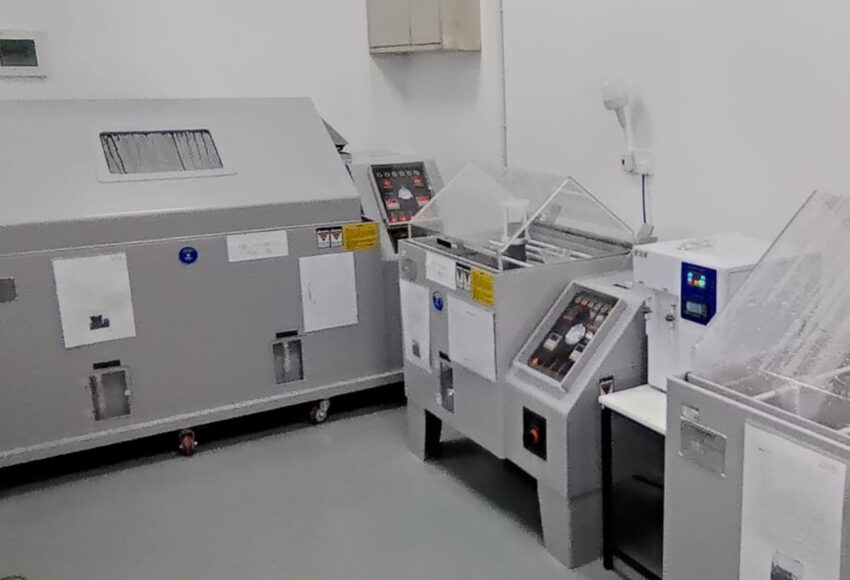
IEC 60068-2-11 Salt Mist Test for Electrical and Electronic Products
IEC 60068-2-11 specifies a salt mist test used to assess the corrosion resistance of electrotechnical products, components, equipment, materials, and protective coatings. The method, designated Test Ka: Salt mist, exposes specimens to a controlled sodium chloride mist to evaluate whether metallic materials and corrosion-protection systems maintain their comparative quality under corrosive conditions.
The current edition is IEC 60068-2-11:2021, Environmental testing – Part 2-11: Tests – Test Ka: Salt mist, published in March 2021. It is the fourth edition and replaced IEC 60068-2-11:1981.
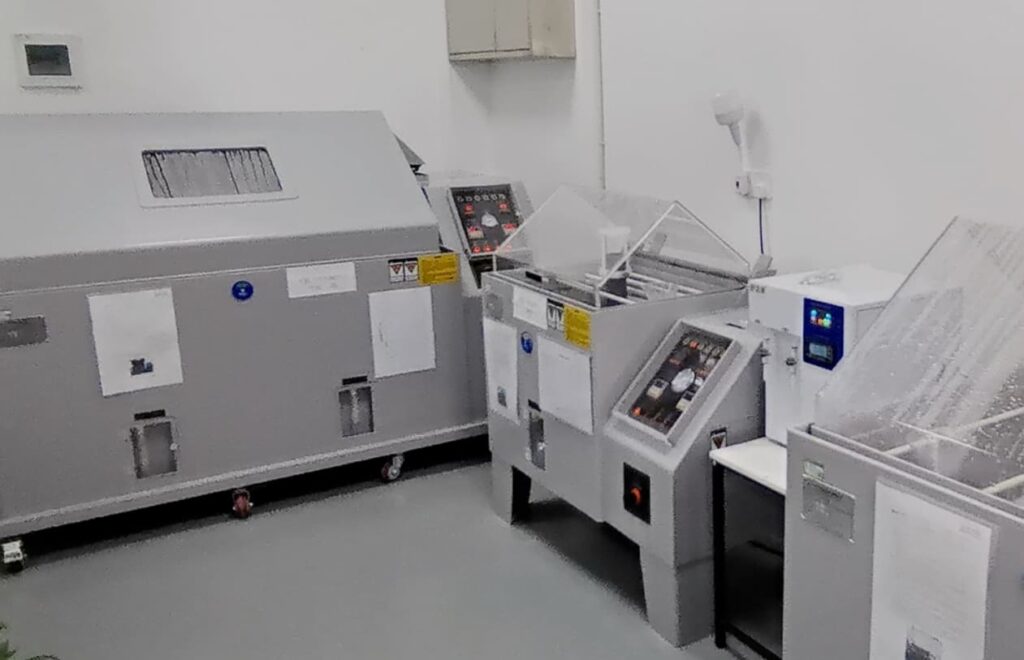
Salt mist testing is particularly useful for detecting pores, discontinuities, coating defects, and variations in corrosion protection. For electrical and electronic products, corrosion can affect terminals, connectors, housings, fasteners, contacts, plated components, and other exposed metallic parts.
What Is IEC 60068-2-11?
IEC 60068-2-11 is part of the broader IEC 60068 environmental testing series. The series provides standardized methods for evaluating how electrotechnical products and components respond to environmental stresses.
IEC 60068-2-11 specifically addresses exposure to a salt mist environment.
According to the IEC, the purpose of the test is to assess the corrosion resistance of:
- Electrotechnical products
- Electrical and electronic components
- Equipment
- Metallic materials
- Protective metallic coatings
- Organic coatings
- Anodic oxide coatings
- Conversion coatings
The test is particularly useful for evaluating the quality and uniformity of corrosion-protective coatings and identifying defects such as pores and other discontinuities.
The test method is commonly referred to as:
IEC 60068-2-11 Test Ka: Salt Mist
This designation is useful because another IEC standard, IEC 60068-2-52, covers Test Kb: Salt mist, cyclic. The two methods address different exposure regimes and should not be treated as interchangeable.
Why Salt Mist Testing Is Important for Electrical and Electronic Products
Electrical and electronic products frequently contain exposed or semi-exposed metallic components.
These can include:
- Terminals
- Connectors
- Screws and fasteners
- Metal housings
- Brackets
- Contact surfaces
- Cable hardware
- Plated components
- Switch components
- Shielding parts
- Mounting hardware
When these surfaces encounter salt-containing moisture, corrosion can develop.
This is particularly relevant to equipment intended for environments where salt contamination may occur, including coastal locations, marine environments, transportation applications, industrial locations, and other salt-laden atmospheres.
Corrosion may cause visible deterioration, but appearance is only one concern for electrical and electronic products.
Depending on the affected component, corrosion can contribute to:
- Increased electrical contact resistance
- Deterioration of conductive surfaces
- Damage to protective finishes
- Degradation of connectors and terminals
- Mechanical weakening
- Reduced reliability of fasteners
- Surface deterioration
- Loss of coating adhesion
- Corrosion at exposed substrate areas
IEC 60068-2-11 provides controlled test conditions that allow these corrosion-protection systems to be evaluated consistently.
What Does IEC 60068-2-11 Test?
The primary purpose of IEC 60068-2-11 is to assess comparative corrosion resistance under a standardized salt mist environment.
The test can be particularly useful when examining the effectiveness and uniformity of protective coatings.
Metallic Materials
Unprotected metallic components can be exposed to determine their behavior under the specified salt mist conditions.
Metallic Coatings
Protective metallic finishes may include coatings applied to steel or other substrates to improve corrosion resistance.
Testing can reveal areas where the coating is discontinuous or insufficiently protective.
Organic Coatings
Painted and other organically coated metallic surfaces can also be evaluated where the applicable product specification calls for IEC 60068-2-11.
Anodic Oxide Coatings
Anodized metal surfaces can contain defects or inconsistencies that affect corrosion protection. Salt mist exposure can assist in detecting weaknesses in the protective layer.
Conversion Coatings
Chemical conversion treatments used to improve surface corrosion resistance can also be evaluated under the method.
IEC specifically identifies the detection of pores and other defects in certain metallic, organic, anodic oxide, and conversion coatings as a useful application of IEC 60068-2-11.
Common Products and Components Tested to IEC 60068-2-11
IEC 60068-2-11 can be referenced for a wide range of electrotechnical products where corrosion resistance is relevant.
Typical examples can include:
- Electrical connectors
- Terminal blocks
- Switch components
- Metal electrical enclosures
- Electronic equipment housings
- Cable connectors and fittings
- Plated contacts
- Fasteners used in electrical equipment
- Metal brackets and mounting components
- Control equipment components
- Telecommunications hardware
- Fibre-optic interconnecting components
- Industrial electrical equipment
The appropriate salt mist requirement ultimately depends on the product standard or technical specification applicable to the equipment.
For example, IEC 61300-2-26:2023 covers salt mist testing for fibre-optic interconnecting devices and passive components and has been harmonized with IEC 60068-2-11:2021.
This illustrates how IEC 60068-2-11 can function as an underlying environmental test method referenced by more product-specific standards.
IEC 60068-2-11 Test Conditions
IEC 60068-2-11 controls several parameters that affect the reproducibility of salt mist testing.
Important variables include:
| Test Parameter | Purpose |
| Salt solution | Creates the chloride-containing corrosive environment |
| Sodium chloride concentration | Controls solution composition |
| pH | Maintains the specified chemical condition |
| Chamber temperature | Controls the exposure environment |
| Atomization | Produces the salt mist |
| Mist collection | Helps verify chamber operation |
| Specimen position | Supports consistent exposure |
| Exposure duration | Defined by the relevant specification |
| Apparatus corrosivity | Confirms suitable chamber performance |
Exact values, tolerances, preparation procedures, and measurement methods should be taken from the current IEC 60068-2-11:2021 standard when establishing a test program.
The 2021 revision also introduced a method for evaluating the corrosivity of the test apparatus, along with examples of typical test equipment.
How Long is an IEC 60068-2-11 Salt Mist Test?
The required salt mist exposure duration depends on the applicable product specification or testing requirement.
A test request should therefore identify the required severity or exposure duration rather than simply stating :test according to IEC 60068-2-11.
Different electrical and electronic products may have different corrosion-resistance expectations based on their:
- Construction
- Materials
- Protective coatings
- Intended environment
- Product standard
- Customer specification
A longer salt mist exposure creates a longer period of corrosive stress, but exposure hours should always be interpreted within the relevant specification.
Salt mist hours alone do not establish how long a product will survive in real-world service.
What Is Evaluated After IEC 60068-2-11 Testing?
Post-test evaluation depends on the type of specimen and the applicable product specification.
Visual Corrosion
The specimen may be examined for:
- Rust
- Corrosion products
- Discoloration
- Pitting
- Surface deterioration
Protective Coating Condition
Coated specimens may be inspected for:
- Blistering
- Peeling
- Flaking
- Coating breakdown
- Local corrosion
- Defects at edges or exposed areas
Electrical Performance
Where required by the applicable product standard, electrical characteristics may be checked before and after salt mist exposure.
Examples can include:
- Contact performance
- Insulation-related characteristics
- Electrical continuity
- Functional operation
The exact measurements depend on the component being tested.
Mechanical Condition
Salt corrosion can also affect mechanically important metallic components.
Inspection may therefore consider:
- Fastener deterioration
- Structural weakening
- Surface damage
- Connector condition
- Mechanical operation
Functional Performance
Complete electrical or electronic products may require functional checks after environmental exposure where specified by the relevant product standard.
Does IEC 60068-2-11 Define Pass/Fail Criteria?
IEC 60068-2-11 does not provide one universal pass/fail requirement for every electrical and electronic product.
The method establishes standardized salt mist exposure used to assess corrosion resistance and comparative quality.
Acceptance criteria should be established by the relevant:
- Product standard
- Component specification
- Customer requirement
- Engineering specification
- Qualification requirement
A complete test specification therefore needs to identify both the IEC 60068-2-11 exposure and the criteria used to determine acceptable performance.
For example, a product specification could require visual examination after exposure together with electrical or functional measurements.
The salt mist method defines the environmental stress. The referenced product requirement determines whether the resulting condition is acceptable.
Common Corrosion Problems Found During Salt Mist Testing
Salt mist testing can reveal weaknesses that may not be obvious during normal visual inspection.
Corrosion of Exposed Metal
Unprotected metal or areas where the protective coating is incomplete may begin corroding during exposure.
Coating Pores and Discontinuities
Small pores can allow the salt solution to reach the underlying substrate.
IEC specifically identifies the detection of these types of coating defects as one of the useful applications of Test Ka.
Poor Plating Coverage
Complex geometries, edges, recesses, threaded areas, and other difficult-to-coat surfaces can have inconsistent plating thickness or coverage.
Corrosion at Dissimilar Metal Interfaces
Assemblies containing different metals may experience localized corrosion problems, depending on the materials and construction.
Coating Adhesion Problems
Salt exposure may contribute to visible deterioration around poorly prepared or inadequately protected surfaces.
Connector and Terminal Corrosion
Corrosion on conductive interfaces can affect the condition of electrical connections and may contribute to performance changes.
Fastener Corrosion
Screws, bolts, washers, clips, and other hardware can corrode when their protective finish is insufficient or damaged.
Why Electrical Products Can Fail Salt Mist Testing
Failure frequently relates to the complete material and coating system.
Inadequate Coating Thickness
Thin or inconsistent coatings can leave areas with reduced corrosion protection.
Poor Surface Preparation
Contaminants such as oil, oxidation, dirt, or processing residues can interfere with coating quality.
Incomplete Plating
Edges, holes, threads, recessed areas, and complex shapes may receive less uniform plating.
Coating Damage During Assembly
Scratches and impact damage can expose the underlying substrate after a protective finish has been applied.
Material Selection
Materials that are unsuitable for the specified environmental requirement may deteriorate quickly during salt mist exposure.
Poor Control of the Coating Process
Changes in cleaning, pretreatment, plating chemistry, coating application, curing, or handling can create variation between production batches.
Where coating performance is important, coating thickness measurement can provide useful supporting information when investigating salt mist failures.
IEC 60068-2-11 vs IEC 60068-2-52
One of the most important distinctions in IEC salt mist testing is the difference between IEC 60068-2-11 Test Ka and IEC 60068-2-52 Test Kb.
| Feature | IEC 60068-2-11 | IEC 60068-2-52 |
| Test designation | Test Ka | Test Kb |
| Test type | Salt mist | Salt mist, cyclic |
| Main focus | Comparative corrosion resistance and coating quality | Resistance of components/equipment to salt-laden atmospheres |
| Exposure pattern | Salt mist test | Cyclic testing |
| Current edition | IEC 60068-2-11:2021 | IEC 60068-2-52:2017 |
| Typical selection | According to applicable product specification | According to applicable product specification |
IEC describes IEC 60068-2-52:2017 as a cyclic salt mist test for components or equipment designed to withstand a salt-laden atmosphere. The cyclic method addresses deterioration of metallic and non-metallic materials caused by salt exposure.
The correct standard should be selected according to the applicable product requirement and intended environmental evaluation.
IEC 60068-2-11 vs ISO 9227
IEC 60068-2-11 and ISO 9227 both use controlled salt mist environments, but they have different scopes.
| Feature | IEC 60068-2-11 | ISO 9227 |
| Standard organization | IEC | ISO |
| Test designation | Test Ka | NSS, AASS, CASS |
| Main application | Electrotechnical products, components, equipment and materials | Metals and protective coatings |
| Main purpose | Assess corrosion resistance and comparative quality | Evaluate corrosion resistance under defined salt spray methods |
| Coating evaluation | Yes | Yes |
| Universal product pass/fail criteria | No | No |
| Product-specific duration | Defined by applicable requirement | Defined by applicable requirement |
ISO 9227 covers three principal salt spray methods: Neutral Salt Spray (NSS), Acetic Acid Salt Spray (AASS), and Copper-Accelerated Acetic Acid Salt Spray (CASS).
IEC 60068-2-11 is particularly relevant when the test requirement comes from an electrotechnical product or component specification.
The test standard cited by the applicable specification should be followed because similar salt mist methods should not automatically be assumed to be technically interchangeable.
IEC 60068-2-11 vs ASTM B117
ASTM B117 is another widely used salt spray standard.
ASTM B117 establishes a standardized practice for operating salt spray fog apparatus and is frequently referenced for metallic products, coatings, plated components, automotive hardware, fasteners, and industrial products.
The standards can be distinguished broadly as follows:
| Feature | IEC 60068-2-11 | ASTM B117 |
| Organization | IEC | ASTM International |
| Primary context | Environmental testing of electrotechnical products | Salt spray testing of metals and coated metals |
| Test environment | Salt mist | Continuous salt spray (fog) |
| Product-specific exposure duration | Specified separately | Specified separately |
| Universal pass/fail requirement | No | No |
| Common use | Electrical/electronic components and equipment | Metallic products and protective coatings |
The applicable standard should be identified from the product specification before testing begins.
IEC 60068-2-11 and Fibre-Optic Components
Salt mist resistance can also be relevant to fibre-optic interconnecting devices and passive components containing metallic parts.
IEC 61300-2-26:2023 provides a salt mist test for determining the corrosion resistance of metals used in fibre-optic interconnecting devices and passive components.
IEC states that this method can be used to determine whether dissimilar metals have been adequately finished to prevent corrosion. The 2023 edition was also harmonized with IEC 60068-2-11:2021.
This is a useful example of how IEC 60068-2-11 supports more specialized component-level environmental testing.
Is IEC 60068-2-11 Suitable for Solar Panels?
Photovoltaic modules have a dedicated IEC salt mist corrosion standard: IEC 61701:2020.
IEC 61701 provides test sequences for determining the resistance of PV modules to corrosion from salt mist. Its current test sequences reference methods including IEC 60068-2-52, along with relevant PV module safety and design qualification standards.
Where a dedicated product standard exists, the requirements of that standard should be reviewed before selecting a general environmental test method.
Can IEC 60068-2-11 Predict Product Life in Coastal Environments?
Salt mist testing provides accelerated laboratory exposure, but the result should not be directly converted into years of field service.
A real coastal environment can involve:
- Changing temperature
- Wet and dry periods
- Humidity variation
- Rain
- Wind
- Airborne chloride
- UV exposure
- Industrial pollution
- Mechanical wear
- Different salt deposition rates
The laboratory test provides controlled conditions for assessing comparative corrosion behavior and coating quality.
For example, a component that meets a specified salt mist exposure requirement has demonstrated performance under that defined test condition. The result does not establish that the component will last a specific number of years beside the sea.
Real-world durability should be evaluated using the appropriate product requirements, material data, environmental classification, and other relevant testing where required.
IEC 60068-2-11 Test Report
A properly documented salt mist test report should provide sufficient information to identify the specimen, test conditions, and results.
Depending on the test program, the report may include:
- Test standard and edition
- Test designation
- Sample identification
- Product description
- Material or coating information
- Number of specimens
- Preconditioning
- Initial examination or measurements
- Salt mist exposure conditions
- Exposure duration
- Specimen orientation
- Recovery procedure
- Final visual examination
- Electrical or functional measurements
- Observed corrosion
- Photographs
- Deviations from the specified procedure
- Evaluation against supplied acceptance criteria
The 2021 revision of IEC 60068-2-11 specifically updated the details associated with test reporting.
Clear reporting is particularly important when results are used for qualification, supplier evaluation, engineering verification, or comparison between production batches.
Information Required Before IEC 60068-2-11 Testing
Before submitting electrical or electronic products for salt mist testing, the test requirement should be clearly defined.
Useful information includes:
- Product name and model
- Material
- Surface finish
- Coating or plating system
- Number of specimens
- Applicable IEC 60068-2-11 edition
- Required exposure duration
- Preconditioning requirements
- Specimen orientation
- Electrical measurements required
- Functional tests required
- Post-test recovery conditions
- Acceptance criteria
- Reporting requirements
Providing this information helps ensure that the test evaluates the product against the intended requirement.
IEC 60068-2-11:2021 provides a standardized method for assessing the corrosion resistance of electrotechnical products, components, equipment, materials, and protective coatings under controlled salt mist conditions.
A reliable testing program should define the applicable standard edition, specimen condition, exposure requirement, post-test evaluation, and acceptance criteria before testing begins. Where a product-specific IEC standard applies, its environmental testing requirements should also be reviewed to determine the appropriate salt mist method and evaluation criteria.

 Request Free Sample Report