

Salt Spray Testing
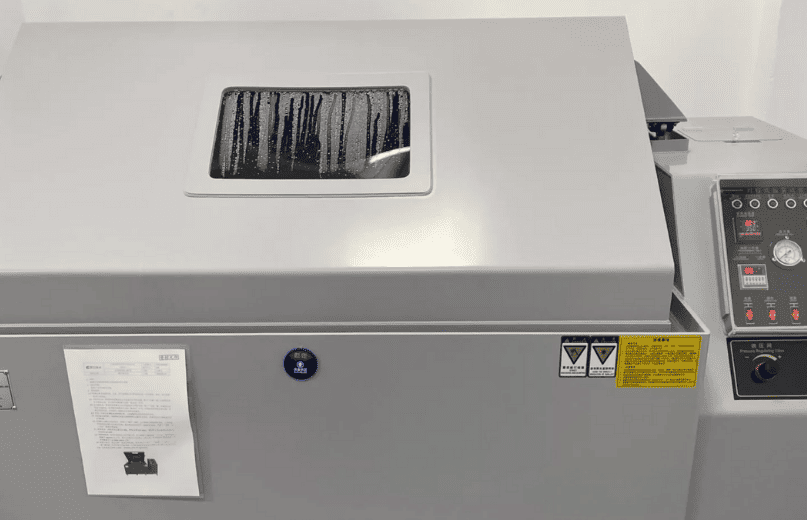
Salt spray testing is an accelerated corrosion test used to evaluate the corrosion resistance of metals, protective coatings, plating, and surface finishes. Test specimens are exposed to a controlled salt-containing fog inside a corrosion chamber for a specified period and then evaluated for corrosion or coating deterioration.
Also known as a salt spray test or salt fog test, the method is widely used for fasteners, automotive components, hardware, powder-coated products, electroplated parts, outdoor products, appliances, and other products where corrosion resistance is an important performance requirement.
Salt spray testing provides controlled and repeatable conditions for comparing materials and surface treatments. The applicable test method, exposure duration, and acceptance criteria should be defined by the relevant standard, product specification, engineering drawing, or customer requirement.
What Is a Salt Spray Test?
A salt spray test exposes a specimen to a fine salt-containing mist inside an enclosed test chamber. Temperature, solution composition, pH, fog collection, specimen positioning, and other conditions are controlled according to the selected test method.
The purpose is to create an accelerated corrosive environment that allows the performance of materials and protective finishes to be evaluated within a defined laboratory period.
Salt spray testing is commonly used for:
- Evaluating corrosion resistance
- Comparing different coating systems
- Assessing electroplated finishes
- Checking coating process consistency
- Evaluating corrosion around damaged coating areas
- Supporting supplier qualification
- Verifying customer or engineering specifications
- Monitoring production quality
A salt spray test does not directly establish how many years a product will last outdoors. Laboratory exposure and natural service environments involve different corrosion mechanisms and environmental variables.
What Does Salt Spray Testing Measure?
Salt spray testing can reveal several forms of corrosion and coating deterioration.
Red Rust
Red rust typically indicates corrosion of an exposed iron or steel substrate. Specifications may define the maximum allowable amount of red rust or require no red rust during a specified exposure period.
White Corrosion
White corrosion products are commonly associated with zinc and zinc-based coatings. Their appearance may be evaluated separately from corrosion of the underlying steel.
Blistering
Moisture and corrosion processes can cause localized swelling or blister formation beneath an organic coating. Blistering can indicate weaknesses in coating adhesion, surface preparation, or coating integrity.
Corrosion Creep
Some coated specimens are intentionally scribed before testing. After exposure, the spread of corrosion from the scribe may be measured according to the applicable evaluation method.
Peeling and Coating Deterioration
Salt spray exposure can reveal coating separation, peeling, cracking, or other visible deterioration that may affect the protective performance of the finish.
The exact characteristics evaluated depend on the material, coating system, test method, and acceptance criteria.
How Does Salt Spray Testing Work?
The detailed procedure depends on the applicable standard, but a typical salt spray test procedure follows several stages.
1. Sample Preparation
Representative specimens are selected and prepared according to the testing requirements.
Before testing, relevant information may include:
- Base material
- Coating or plating type
- Coating thickness
- Surface condition
- Specimen dimensions
- Required test duration
- Acceptance criteria
Some specifications require the coating to remain intact, while others require a controlled scribe through the coating before exposure.
2. Specimen Placement
Samples are positioned inside the salt spray chamber according to the applicable standard.
Specimen orientation is controlled because positioning can influence the amount of salt fog reaching the test surface. Samples should also be arranged so that condensate from one specimen does not improperly affect another.
3. Preparation of the Test Solution
A salt solution is prepared according to the selected test method.
The required salt concentration, water quality, pH, and other solution parameters depend on the standard and whether the test uses NSS, AASS, CASS, or another corrosion method.
4. Salt Fog Exposure
The chamber generates a fine mist that creates a controlled corrosive environment around the specimens.
During testing, operating conditions are maintained within the limits specified by the applicable method. Depending on the standard, monitored parameters can include:
- Chamber temperature
- Solution concentration
- pH
- Fog collection rate
- Exposure duration
5. Exposure for the Specified Duration
Specimens remain in the chamber for the required exposure period.
Common specifications may require 24, 48, 72, 96, 240, 500, 1,000 hours or longer.
The required number of hours must come from the applicable product or coating requirement. Salt spray standards generally describe the test conditions and procedure, while product specifications or customer requirements frequently establish the required exposure period.
6. Evaluation of Test Specimens
At the specified inspection point or after completing the exposure period, specimens are evaluated according to the agreed criteria.
Evaluation may consider:
- Red rust
- White corrosion
- Blistering
- Peeling
- Surface deterioration
- Corrosion around a scribe
- Percentage of affected area
The observed results are then compared with the specified acceptance requirements.
Salt Spray Test Conditions
There is no single set of operating conditions that applies to every type of salt spray test.
For example, Neutral Salt Spray (NSS) commonly uses a neutral sodium chloride solution, while AASS and CASS use different solution chemistry and pH conditions to create more aggressive environments for particular applications.
This distinction matters when specifying a test. A requirement stating only 500-hour salt spray test may be incomplete because the testing laboratory may also need to know:
- Test standard
- Test method
- Sample preparation
- Exposure duration
- Inspection intervals
- Acceptance criteria
These details allow the test to be conducted and evaluated consistently.
Salt Spray Testing Standards
Several standards are used for salt spray corrosion testing.
| Standard | Scope / Common Use |
| ASTM B117 | Standard practice for operating salt spray (fog) apparatus |
| ISO 9227 | NSS, AASS and CASS testing of metallic materials and corrosion protection |
| JIS Z 2371 | Japanese standard for salt spray testing |
| IEC 60068-2-11 | Salt mist environmental testing for electrotechnical products |
| GB/T 10125 | Chinese standard covering artificial atmosphere corrosion testing |
The correct standard depends on the product specification, market, coating system, customer requirement, or engineering documentation.
ASTM B117 Salt Spray Test
ASTM B117 is one of the most widely referenced salt spray testing practices.
It establishes controlled procedures for operating salt spray apparatus, including requirements related to:
- Test chamber conditions
- Salt solution
- Temperature
- Fog collection
- Specimen positioning
- Test continuity
An important point is that ASTM B117 does not provide one universal pass/fail requirement for all products.
A specification might require a zinc-plated component to complete a defined exposure period without exceeding an allowable level of corrosion. Another product may have different acceptance criteria even when both are tested using ASTM B117.
This is why the test standard and the product acceptance requirement should be identified separately.
ISO 9227 Salt Spray Test
ISO 9227 covers artificial atmosphere corrosion tests for metallic materials with or without corrosion protection.
Three commonly referenced methods are:
Neutral Salt Spray (NSS)
NSS uses a neutral salt solution and is widely applied to metallic materials, coatings, plating systems, and corrosion-protection processes.
Acetic Acid Salt Spray (AASS)
AASS uses an acidified salt solution and is used for certain metallic and decorative coating systems.
Copper-Accelerated Acetic Acid Salt Spray (CASS)
CASS adds copper chloride to an acidified salt solution, creating a more aggressive test environment. It is commonly associated with certain decorative coating systems, including copper/nickel/chromium and nickel/chromium coatings.
For detailed requirements covering these methods, see the ISO 9227 Salt Spray Testing Guide.
NSS vs AASS vs CASS
Although all three methods expose specimens to a salt-containing environment, their test conditions and applications differ.
| Method | Full Name | General Application |
| NSS | Neutral Salt Spray | General metallic materials and protective coatings |
| AASS | Acetic Acid Salt Spray | Certain metallic and decorative coatings |
| CASS | Copper-Accelerated Acetic Acid Salt Spray | More aggressive evaluation of certain decorative coatings |
A 24-hour CASS test therefore cannot be treated as equivalent to a 24-hour NSS test. The exposure chemistry and severity differ.
The method should be selected according to the relevant specification.
How Long Is a Salt Spray Test?
Salt spray tests may run from several hours to hundreds or thousands of hours.
Common specified durations include:
| Test Duration | Typical Context |
| 24 hours | Short-duration corrosion evaluation |
| 48 hours | Basic coating or plating requirements |
| 72–96 hours | General coated or plated components |
| 240 hours | Higher corrosion resistance requirements |
| 500 hours | Extended coating performance requirements |
| 1,000+ hours | Long-duration specifications |
These values are examples of commonly encountered test periods. They are not universal salt spray acceptance criteria.
For example, two powder-coated components may both undergo 500 hours of salt spray exposure while having different requirements for blistering, rusting, or corrosion creep.
The correct test duration should therefore be determined from:
- Product specifications
- Engineering drawings
- Coating specifications
- OEM requirements
- Customer requirements
- Applicable industry standards
See Salt Spray Test Requirements by Product Type and Industry for further guidance on selecting test durations.
How Are Salt Spray Test Results Evaluated?
A salt spray test result cannot be determined from the exposure duration alone.
For example:
500 hours ASTM B117
describes the test method and exposure period, but it does not fully define the acceptance criteria.
A complete requirement might also specify:
- No red rust on defined surfaces
- Maximum permitted white corrosion
- Maximum blistering
- Maximum corrosion creep from a scribe
- Maximum percentage of affected surface
- Areas that should be excluded from evaluation
The acceptance criteria should therefore be established before the test begins.
Pass or Fail Criteria
A specimen passes when its condition after the specified exposure meets the defined acceptance criteria.
A failure may involve excessive:
- Red rust
- White corrosion
- Blistering
- Peeling
- Corrosion creep
- Coating deterioration
Visual observations, measurements, photographs, or standardized corrosion rating methods may be used depending on the test specification.
What Products Are Salt Spray Tested?
Salt spray testing is applicable to many products containing corrosion-sensitive metals or protective surface treatments.
Fasteners and Hardware
Common examples include:
- Screws
- Bolts
- Nuts
- Washers
- Hinges
- Locks
- Brackets
- Door hardware
Coatings such as zinc plating, galvanizing, and other protective finishes are frequently evaluated for corrosion resistance.
Powder-Coated Products
Powder coating salt spray testing can be used for:
- Outdoor furniture
- Metal frames
- Equipment housings
- Fencing
- Appliances
- Architectural components
- Industrial equipment
Performance can be affected by coating thickness, pretreatment, curing, adhesion, substrate preparation, and coating formulation.
Automotive Components
Automotive applications may include:
- Fasteners
- Brackets
- Clips
- Chassis components
- Plated parts
- Coated metal components
The applicable requirements are often defined by OEM or component-specific specifications.
Electrical and Electronic Products
Salt spray testing may be applied to corrosion-sensitive metallic components such as:
- Enclosures
- Brackets
- Connectors
- Metal housings
- Mounting components
Environmental test requirements should be selected according to the intended product and application.
Outdoor and Construction Products
Products exposed to moisture or outdoor environments frequently contain protective finishes designed to reduce corrosion.
Examples include:
- Outdoor furniture
- Fencing
- Railings
- Construction hardware
- Lighting components
- Metal fixtures
Marine-Related Components
Salt-rich environments create significant corrosion challenges for metal components. Salt spray testing may therefore form part of a broader corrosion evaluation program for marine-related hardware and components.
Salt Spray Testing for Powder Coatings
Powder-coated products are a common application for corrosion testing because the coating acts as a protective barrier between the metal substrate and the surrounding environment.
Salt spray exposure can reveal problems related to:
- Poor pretreatment
- Inadequate coating thickness
- Incomplete coverage
- Contamination
- Poor adhesion
- Incorrect curing
- Damage to the coating
Some coating specifications require the specimen to be scribed before testing so that corrosion spreading beneath the coating can be evaluated.
The coating formulation alone does not determine salt spray performance. Surface preparation, pretreatment, application, curing, and coating integrity can significantly affect the result.
What Causes a Salt Spray Test to Fail?
When a coated product performs poorly during salt spray exposure, the cause may be related to the material, coating, or manufacturing process.
Common causes include:
- Poor surface preparation
- Inadequate pretreatment
- Insufficient coating thickness
- Uneven coating coverage
- Incorrect curing
- Surface contamination
Failures should be investigated in relation to the location and type of corrosion observed. For a detailed explanation of these failure mechanisms and corrective actions, see Why Products Fail Salt Spray Testing.
Limitations of Salt Spray Testing
Salt spray testing provides an accelerated and controlled corrosion environment, but the test does not reproduce every condition encountered during actual product use.
Real-world corrosion can also be influenced by:
- Wet and dry cycles
- Temperature changes
- UV radiation
- Mechanical wear
- Industrial pollutants
- Chemicals
- Humidity fluctuations
- Material combinations
A salt spray test therefore should not be interpreted as a direct conversion between laboratory hours and years of outdoor service.
For example, 500 hours of salt spray exposure does not mean that a product will last a specific number of years outdoors.
Salt spray testing is most useful when the test method and acceptance criteria are clearly defined for evaluating or comparing a material, coating, process, or product.
Salt spray testing provides a standardized method for evaluating corrosion resistance under controlled laboratory conditions. Reliable testing requires three elements to be defined clearly: the applicable test method, exposure duration, and acceptance criteria.
When a product specification requires independent laboratory evaluation, salt spray testing services can be used to verify corrosion performance according to the specified standard and test conditions.

 Request Free Sample Report