


Acceptable Quality Limit (AQL): Complete Guide for Quality Control

Acceptable Quality Limit (AQL) is a statistical sampling method used to determine the maximum number of defects that can be accepted in a production lot during quality inspection. Instead of inspecting every product, AQL uses a representative sample to decide whether an entire batch should be accepted or rejected.
AQL is widely used in product inspections because it provides a practical balance between quality assurance and inspection efficiency. It helps buyers and manufacturers apply consistent quality standards while reducing inspection time and costs.
The methodology is based on internationally recognized standards, including:
- ISO 2859-1
- ANSI/ASQ Z1.4
These standards define how sample sizes and acceptance criteria should be determined during inspections.
Why is AQL Important?
Inspecting every product in a shipment is often impractical, especially for large production orders. AQL provides a standardized approach for evaluating quality with a statistically valid sample.
The use of AQL helps businesses:
- Establish clear quality expectations
- Reduce inspection costs and time
- Standardize inspection decisions
- Improve supplier quality management
- Reduce the risk of defective products reaching customers
- Support consistent quality control across multiple suppliers and factories
Because of these benefits, AQL has become one of the most widely used quality control methods in international trade.
How Does AQL Work?
AQL works by selecting a sample from a production lot and comparing the number of defects found against predetermined acceptance limits.
The process generally involves the following steps:
- Determine the lot size.
- Select the inspection level.
- Choose the AQL values.
- Determine the sample size.
- Inspect the sample.
- Compare the defect count with the acceptance limits.
- Accept or reject the lot.
If the number of defects found is equal to or below the acceptance number, the shipment passes inspection. If the defect count exceeds the rejection number, the lot fails inspection.
Example of an AQL Inspection
A shipment contains:
- Lot size: 5,000 units
- Inspection level: General Level II
- Critical defects: AQL 0
- Major defects: AQL 2.5
- Minor defects: AQL 4.0
According to the AQL table:
- Sample size code letter: L
- Sample size: 200 pieces
- Maximum major defects allowed: 10
- Maximum minor defects allowed: 14
The inspection results are:
- Critical defects: 0
- Major defects: 7
- Minor defects: 11
Because the defect counts remain within the acceptance limits, the shipment passes inspection.
AQL Defect Classifications
Defects identified during inspection are generally classified into three categories.
Critical Defects
Critical defects create safety hazards, regulatory violations, or conditions that make the product dangerous or unusable.
Examples include:
- Electrical shock hazards
- Sharp points on children’s products
- Contaminated food products
- Missing safety components
Most buyers use:
Critical AQL: 0
because no safety defect is considered acceptable.
Major Defects
Major defects affect the product’s functionality, usability, or performance.
Examples include:
- Broken components
- Non-functional products
- Incorrect assembly
- Missing accessories
Common AQL values for major defects include:
- 1.0
- 1.5
- 2.5
Minor Defects
Minor defects are cosmetic issues that do not affect the intended use of the product.
Examples include:
- Small scratches
- Slight color differences
- Minor packaging imperfections
- Label misalignment
Common AQL values for minor defects include:
- 4.0
- 6.5
Key Components of AQL
Lot Size
Lot size refers to the total number of products produced under similar conditions and presented for inspection.
Examples:
- 500 pieces
- 5,000 pieces
- 50,000 pieces
Lot size determines the sample size code letter used during inspection.
Sample Size
Sample size is the number of units selected for inspection.
A larger sample generally provides greater confidence in the inspection results but requires more inspection time.
AQL Values
AQL values define the maximum number of defects permitted within the sample.
Common values include:
- 0
- 0.65
- 1.0
- 1.5
- 2.5
- 4.0
- 6.5
Different AQL values can be applied to critical, major, and minor defects.
Inspection Levels
Inspection levels determine how many samples are selected from a production lot.
General Inspection Levels
- General Level I
- General Level II
- General Level III
General Level II is the most commonly used inspection level and is considered the standard for most product inspections.
Special Inspection Levels
- S1
- S2
- S3
- S4
Special levels are often used for:
- Functional testing
- Destructive testing
- Laboratory testing
- Limited inspections
Understanding AQL Sampling Tables
AQL sampling tables consist of two sections.
Table 1: Sample Size Code Letters
This table converts:
- Lot size
- Inspection level
into a sample size code letter.
Table 2: Sampling Plan
This table converts the code letter into:
- Sample size
- Acceptance number
- Rejection number
Together, these tables provide a standardized method for determining inspection requirements.
How to Read an AQL Table
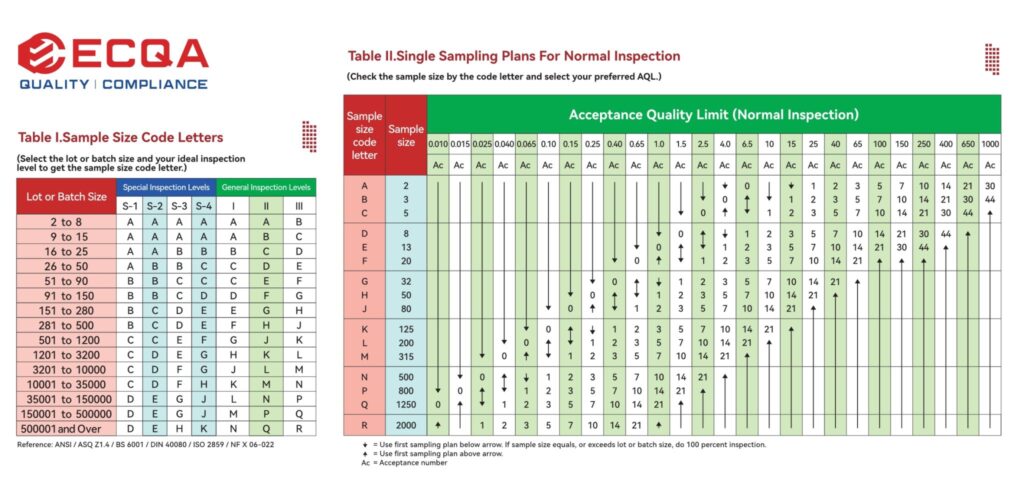
Step 1: Determine the Lot Size
Example:
5,000 units.
Step 2: Select the Inspection Level
Example:
General Inspection Level II.
Step 3: Select the AQL Values
Example:
- Critical: 0
- Major: 2.5
- Minor: 4.0
Step 4: Find the Sample Size Code Letter
The code letter is:
L
Step 5: Determine the Sample Size
Code letter L corresponds to:
200 pieces.
Step 6: Inspect the Sample
Inspect the selected units and record all defects.
Step 7: Compare the Defect Count
If the number of defects remains within the acceptance limits, the shipment passes inspection.
For a quicker calculation, you can use our AQL Calculator or download our Free AQL Chart PDF.
Common AQL Levels Used in Product Inspection
| Defect Type | Common AQL |
|---|---|
| Critical | 0 |
| Major | 2.5 |
| Minor | 4.0 |
This combination is widely used for consumer products and general merchandise inspections.
However, different industries and products may adopt stricter or more flexible quality standards.
How to Choose the Right AQL Level
Selecting the correct AQL level depends on several factors.
Product Criticality
Products that may create safety risks often require stricter AQL values.
Examples include:
- Medical devices
- Children’s products
- Automotive components
Product Complexity
Products with multiple parts and functions often require lower AQL values.
Supplier Performance
Suppliers with a strong quality history may justify more flexible AQL requirements.
Market Requirements
Certain industries and destination markets impose stricter quality requirements.
Risk Tolerance
Premium products and highly regulated products often require lower defect thresholds.
Industries That Use AQL
AQL sampling is widely used across many industries, including:
- Consumer products
- Electronics
- Toys
- Apparel and textiles
- Furniture
- Home appliances
- Industrial products
- Automotive components
- Medical devices
Benefits of AQL
Improves Inspection Efficiency
Sampling inspections reduce the need to inspect every product.
Supports Consistent Quality Decisions
A standardized methodology helps ensure consistent inspection results across factories and suppliers.
Reduces Inspection Costs
AQL minimizes inspection resources while maintaining statistically valid conclusions.
Improves Supplier Accountability
Clear defect limits establish measurable quality expectations.
Reduces Quality Risks
AQL helps identify quality issues before products are shipped to customers.
Common Challenges When Using AQL
Incorrect Sampling
Improper sample selection can reduce the reliability of inspection results.
Unclear Defect Definitions
Poorly defined defect criteria often lead to disputes between buyers and suppliers.
Inconsistent Inspection Procedures
Lack of standardized inspection methods can produce inconsistent results.
Misunderstanding of AQL
AQL does not guarantee that every product in a shipment is defect-free. It is a statistical method used to manage quality risks.
AQL and International Standards
The two most widely used AQL standards are:
- ISO 2859-1
- ANSI/ASQ Z1.4
These standards provide internationally recognized sampling procedures and are accepted across many industries and countries.
Acceptable Quality Limit (AQL) is one of the most widely used quality control methods for determining whether a production lot meets predefined quality requirements. By applying statistical sampling methods based on ISO 2859-1 and ANSI/ASQ Z1.4, businesses can make consistent inspection decisions while controlling costs and managing quality risks.
Need to calculate sample sizes automatically? Try our Free AQL Calculator.
Frequently Asked Questions
1. What is AQL?
AQL stands for Acceptable Quality Limit and defines the maximum number of defects allowed in an inspection sample before a production lot is rejected.
2. Does AQL guarantee zero defects?
No. AQL is a statistical sampling method and does not guarantee that every unit in a production lot is defect-free.
3. What is the most common AQL level?
Many inspections use:
Critical: 0
Major: 2.5
Minor: 4.0
4. What is the difference between AQL and 100% inspection?
AQL uses statistical sampling to evaluate a production lot, while 100% inspection requires every unit to be inspected.
5. Which AQL standard is most widely used?
ISO 2859-1 and ANSI/ASQ Z1.4 are the most widely used AQL sampling standards.

 Request Free Sample Report