

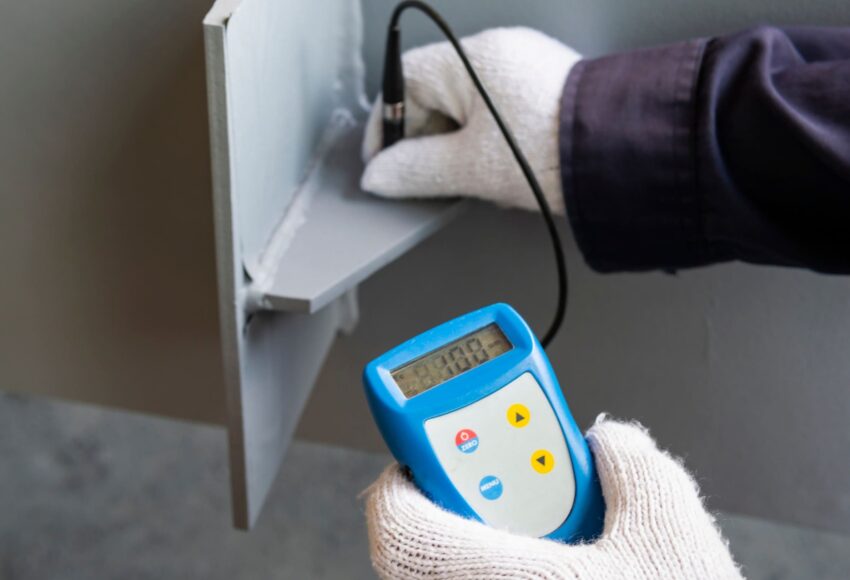
Coating Thickness Testing
Coating thickness testing is the process of measuring the thickness of a protective or decorative coating applied to a material or finished product. The test verifies whether the coating meets specified thickness requirements to ensure corrosion resistance, wear protection, product durability, and overall quality.
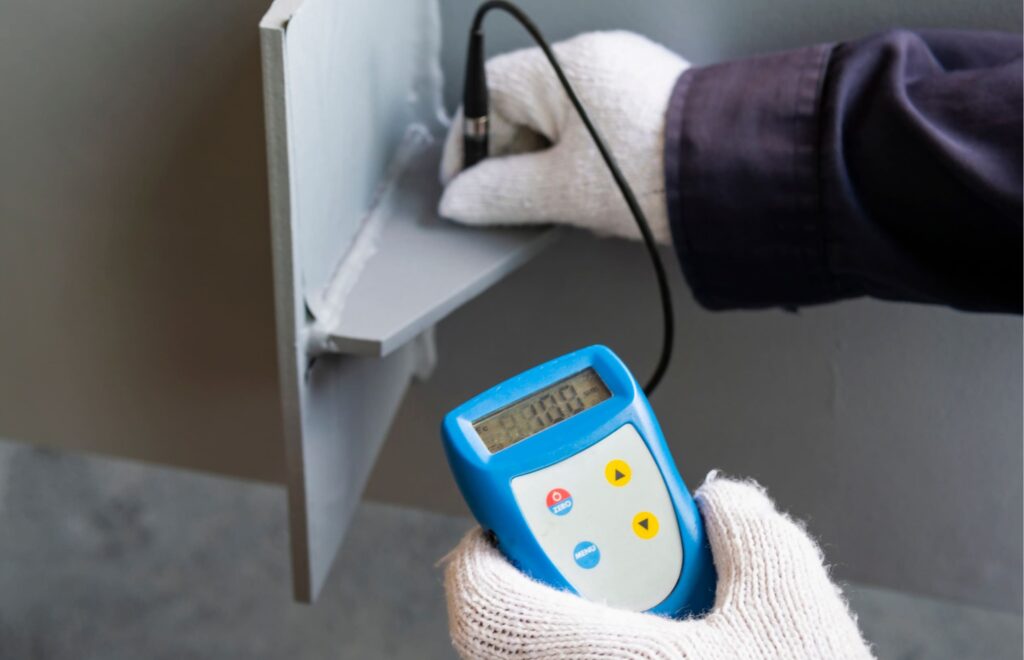
Coatings such as paint, powder coating, electroplating, galvanizing, anodizing, and thermal spray coatings are commonly applied to improve product performance and extend service life. Each coating system requires a specified thickness range to provide the intended level of protection.
Measured coating thickness is compared against engineering drawings, customer specifications, or international standards to determine whether the product meets the required acceptance criteria. Results that fall outside the specified range may indicate problems with the coating process, surface preparation, or equipment calibration.
Because coating thickness directly affects product performance, the test is widely used during incoming inspection, in-process quality control, final inspection, supplier evaluation, and product testing across many manufacturing industries.
Why is Coating Thickness Testing Important?
The performance of a coated product depends not only on the coating material but also on the thickness of the applied coating.
A coating that is too thin may not provide adequate protection against corrosion, abrasion, chemicals, or environmental exposure. Conversely, an excessively thick coating may lead to cracking, peeling, poor adhesion, dimensional issues, or unnecessary material costs.
Coating thickness testing helps manufacturers verify that coatings have been applied consistently throughout production and comply with specified requirements.
The test is commonly used to:
- Verify compliance with engineering specifications
- Confirm coating quality before shipment
- Monitor production consistency
- Support incoming material inspection
- Evaluate supplier performance
- Reduce product failures and warranty claims
- Support product acceptance decisions
Accurate coating thickness measurement allows manufacturers to identify coating process variations before products reach customers, reducing the likelihood of costly rework or product rejection.
Industries That Use Coating Thickness Testing
Coating thickness measurement is widely used across manufacturing industries where protective coatings play an important role in product performance and service life.
Common industries include:
- Automotive
- Aerospace
- Construction
- Electronics
- Household appliances
- Furniture
- Oil and gas
- Marine equipment
- Steel fabrication
- Medical devices
- Industrial machinery
- Metal component manufacturing
Products inspected may include structural steel, automotive parts, aluminum components, pipelines, fasteners, electrical enclosures, consumer products, and precision-machined components.
Coating Thickness Testing Methods
Several measurement methods are available depending on the coating type, substrate material, required accuracy, and inspection environment.
These methods are generally divided into non-destructive and destructive testing techniques.
Non-Destructive Testing Methods
Non-destructive methods measure coating thickness without damaging the finished product. These techniques are widely used during production and final inspection because they provide fast and repeatable measurements.
Magnetic Method
The magnetic method measures non-magnetic coatings on ferromagnetic substrates, such as steel.
Typical applications include:
- Paint on steel
- Powder coating on steel
- Zinc coatings on steel
- Plastic coatings on steel
Because the method is portable and easy to use, it is commonly applied during incoming inspection, in-process inspection, and pre-shipment inspection.
Eddy Current Method
The eddy current method is used for non-conductive coatings applied to non-ferrous metals such as aluminum, brass, or copper.
Common applications include:
- Paint on aluminum
- Powder coating on aluminum
- Anodized aluminum
- Plastic coatings on aluminum
This method provides accurate measurements for thin coatings and is widely used throughout the electronics, automotive, and aerospace industries.
Ultrasonic Method
Ultrasonic coating thickness testing uses high-frequency sound waves to determine coating thickness.
Unlike magnetic and eddy current methods, ultrasonic testing can measure certain coatings applied to both metallic and non-metallic substrates.
It is commonly used for:
- Thick protective coatings
- Multi-layer coating systems
- Plastic substrates
- Composite materials
- Fiberglass components
Because ultrasonic testing can evaluate thicker coatings without damaging the product, it is frequently used for corrosion protection systems and industrial coatings.
Destructive Testing Methods
Destructive testing methods require the coating or product sample to be cut, removed, or altered during measurement.
Although these methods cannot be performed on finished products intended for shipment, they provide highly accurate measurements and are commonly used for laboratory analysis, process validation, and failure investigations.
Cross-Section Microscopy
Cross-section microscopy involves cutting a coated sample and examining it under a microscope.
The coating thickness is measured directly from the prepared cross-section.
This method provides excellent accuracy and is often used for:
- Laboratory testing
- Product development
- Coating failure investigations
- Verification of complex coating systems
Gravimetric Method
The gravimetric method estimates coating thickness by measuring the weight difference before and after removing the coating.
The thickness is calculated using the coating’s density and the measured mass difference.
This technique is primarily used for certain plated coatings where laboratory measurements are required.
Choosing the Right Coating Thickness Testing Method
Selecting the appropriate testing method depends on several factors, including the substrate material, coating type, required accuracy, and inspection environment.
Using the wrong measurement method can lead to inaccurate results and incorrect quality decisions.
The table below summarizes the most commonly used methods.
| Testing Method | Suitable Substrate | Typical Coatings | Destructive |
| Magnetic Method | Steel | Paint, powder coating, zinc | No |
| Eddy Current Method | Aluminum, copper, brass | Paint, anodizing, powder coating | No |
| Ultrasonic Method | Metal and some non-metal substrates | Thick and multi-layer coatings | No |
| Cross-Section Microscopy | All materials | Most coating systems | Yes |
| Gravimetric Method | Various plated materials | Electroplated coatings | Yes |
For production quality control, non-destructive testing methods are generally preferred because they provide fast measurements without damaging finished products.
Laboratory methods are typically used for product development, failure analysis, and process validation where higher measurement accuracy is required.
International Standards for Coating Thickness Testing
Coating thickness measurements should follow recognized international standards to ensure consistency, repeatability, and acceptance across different industries.
ISO Standards
Common ISO standards include:
ISO 2178
Magnetic method for measuring non-magnetic coatings on ferromagnetic substrates.
ISO 2360
Eddy current method for measuring non-conductive coatings on non-ferrous metals.
ISO 2808
Methods for measuring coating thickness on paint systems.
ISO 19840
Measurement of dry film thickness for protective paint systems applied to steel structures.
ASTM Standards
Frequently used ASTM standards include:
ASTM D7091
Dry film thickness measurement using magnetic and eddy current gauges.
ASTM E376
Standard practice for measuring coating thickness using magnetic-field or eddy-current instruments.
ASTM B499
Magnetic method for measuring metallic coatings on magnetic substrates.
Following these standards helps ensure measurement procedures remain consistent between manufacturers, laboratories, inspection companies, and customers.
Factors That Affect Measurement Accuracy
Several factors can influence coating thickness measurements.
Understanding these variables helps improve testing accuracy and reduces the likelihood of inconsistent results.
Common factors include:
Surface Roughness
Rough or uneven surfaces can cause coating thickness gauges to produce variable readings.
Multiple measurements are often required to obtain representative results.
Instrument Calibration
Coating thickness gauges should be calibrated using certified calibration standards before testing begins.
Poor calibration may result in systematic measurement errors.
Substrate Material
Different substrate materials require different testing principles.
For example:
- Steel generally uses magnetic measurement.
- Aluminum commonly uses eddy current measurement.
Selecting the incorrect measurement method may produce unreliable results.
Coating Type
Different coating materials respond differently to measurement instruments.
Paint, powder coating, anodizing, galvanizing, electroplating, and thermal spray coatings may each require different testing approaches.
Curved or Complex Surfaces
Small components, curved surfaces, edges, and corners may produce readings that differ from measurements taken on flat surfaces.
Proper probe placement and multiple measurements help improve accuracy.
Operator Technique
Measurement consistency also depends on proper instrument handling.
Inspectors should follow standardized testing procedures regarding probe placement, measurement frequency, and reporting methods.
Applications of Coating Thickness Testing in Quality Control
Coating thickness testing is performed throughout the manufacturing process to verify coating quality and maintain process consistency.
Incoming Inspection
Incoming inspection verifies the coating quality of purchased materials and components before production begins.
Typical objectives include:
- Confirming coating thickness specifications
- Verifying supplier quality
- Preventing non-conforming materials from entering production
In-Process Inspection
During production, coating thickness measurements help monitor coating application and process stability.
Regular measurements allow manufacturers to detect variations early and make adjustments before large quantities of products are affected.
Final Inspection
Final inspection verifies that finished products comply with coating thickness requirements before shipment.
Measurements are compared with customer specifications or engineering drawings to determine product acceptance.
This final verification helps reduce customer complaints, shipment rejection, and warranty claims.
Supplier Quality Evaluation
Many organizations include coating thickness testing as part of supplier qualification and ongoing supplier performance monitoring.
Consistent measurement data helps evaluate manufacturing capability and process control across different suppliers.
Failure Investigation
When coating failures such as corrosion, peeling, blistering, or premature wear occur, coating thickness measurements are often performed during root cause analysis.
The results help determine whether insufficient or excessive coating thickness contributed to the failure.
How to Interpret Coating Thickness Test Results
Measured coating thickness should always be evaluated against the applicable specification or acceptance criteria.
Coating Below Specification
A coating that is thinner than specified may lead to:
- Reduced corrosion resistance
- Shorter service life
- Increased wear
- Premature coating failure
- Product rejection
Coating Above Specification
Excessively thick coatings may result in:
- Poor adhesion
- Cracking
- Peeling
- Increased material consumption
- Dimensional issues
- Assembly difficulties
Coating Within Specification
When measurements fall within the specified tolerance range, the coating generally meets the required thickness criteria.
Products may then proceed to the next production stage or be accepted for shipment, provided all other inspection requirements have also been satisfied.
Coating thickness testing is an essential quality control process that verifies whether protective coatings meet specified thickness requirements and perform as intended. By selecting the appropriate measurement method, following internationally recognized standards, and conducting inspections throughout production, manufacturers can improve coating consistency, reduce product failures, and support compliance with customer and regulatory requirements.
Related Articles:
- Coating Thickness Requirements by Product Type and Industry
- Salt Spray Testing
- Tensile Strength Testing Explained
- Hardness Testing: Methods, Standards, and Applications
Frequently Asked Questions
1. What is coating thickness testing?
Coating thickness testing measures the thickness of protective or decorative coatings applied to a product to verify compliance with specifications and quality requirements.
2. Why is coating thickness important?
Coating thickness directly affects corrosion resistance, durability, wear protection, product appearance, and overall service life.
3. What is dry film thickness (DFT)?
Dry Film Thickness (DFT) refers to the thickness of a coating after it has fully cured or dried. Many coating specifications define acceptable DFT ranges for product acceptance.
4. Is coating thickness testing destructive?
Most production inspections use non-destructive methods such as magnetic or eddy current testing. Destructive methods, including cross-section microscopy, are generally reserved for laboratory analysis or failure investigations.

 Request Free Sample Report