
Kitchen Appliances Inspection
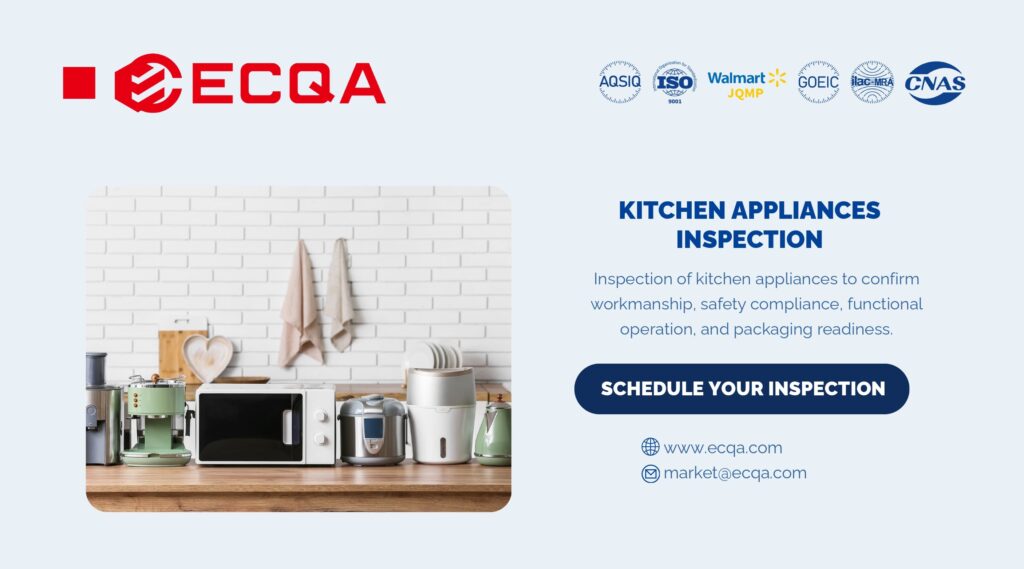
Kitchen appliances inspection is the evaluation of electrical and non-electrical kitchen products to verify workmanship, functional performance, electrical safety, labeling accuracy, and packaging condition before shipment. Products may include blenders, kettles, toasters, rice cookers, air fryers, coffee makers, ovens, food processors, and other countertop appliances used in food preparation.
Inspection activities typically include visual review, product specification verification, electrical and functional checks, simulated use testing, labeling assessment, and packaging verification. These procedures help determine whether kitchen appliances meet defined requirements for quality, safety, and shipment readiness.
ECQA provides independent kitchen appliances inspection services based on these assessment principles to support quality control, reduce shipment risk, and verify product conformity before distribution.
Key Aspects of Kitchen Appliances Inspection
- Workmanship and appearance: Inspection of product surfaces, interior cleanliness, paint finish, scratch marks, assembly condition, and overall presentation.
- Product description, style, color, and labeling: Verification that the product matches approved specifications, sample reference, model details, color, markings, and required labels.
- Electrical safety testing: Checks may include earth continuity, electric strength, power input and current, high voltage, and starting voltage evaluation.
- Power cord assessment: Review of power cord attachment, pull resistance, and conductor cross-sectional area.
- Label durability and barcode verification: Rubbing test on rating labels and confirmation that barcodes are readable and consistent with product information.
- Functional testing: Verification that all declared functions operate correctly and that switches, controls, indicators, and operating modes perform as intended.
- Dimensions and weight verification: Measurement of product size and weight against approved specifications.
- Simulated use testing: Operation of the appliance under practical use conditions to assess basic performance and suitability for intended food preparation tasks.
- Desiccant and moisture checks: Confirmation of desiccant presence where required and measurement of moisture content for any applicable wood components.
- Thermal and safety component checks: Verification of thermal fuse cut-off function and related safety features where applicable.
- Stability, tape, and color checks: Assessment of product balance, attachment quality, protective tape condition, and color consistency.
- Timer and temperature verification: Review of timer accuracy and temperature control performance for applicable appliances.
- Burn-in test: Continuous operation test to assess basic durability and long-run functional stability.
- Packaging condition: Verification that inner and outer packaging meets specifications, with checks that may include carton drop testing where required.
- Technical documentation: Review of certificates, product-related documents, and confirmation that critical components align with the approved test report and Critical Design Features.
Types of Kitchen Appliance Defects or Risks Typically Found
- Scratches, stains, dents, or poor paint finish on visible surfaces
- Loose components, poor assembly, or uneven fitting
- Incorrect model, color, rating label, or barcode information
- Faulty switches, controls, indicators, or operating functions
- Power cord weakness or poor attachment
- Electrical safety issues identified during on-site checks
- Inaccurate timer or temperature settings
- Thermal fuse malfunction or inconsistent heating performance
- Instability during use or structural weakness
- Packaging damage or insufficient transport protection
- Missing certificates or mismatch between product components and technical documentation
Why Kitchen Appliances Inspection Is Important
- Quality consistency: Confirms that workmanship, finish quality, and assembly condition meet defined requirements before shipment.
- Functional reliability: Verifies that appliance functions, controls, and performance are consistent with product specifications.
- Electrical safety support: Helps identify safety-related issues during inspection and supports product quality verification before market distribution.
- Specification conformity: Confirms that product description, style, color, dimensions, labeling, and packaging match approved references.
- Risk reduction: Helps reduce returns, complaints, shipment delays, and product issues caused by defects or nonconformity.
Kitchen Appliance Product Categories Covered
ECQA offers kitchen appliance inspections to verify that a wide range of appliances function properly and meet defined requirements for quality and performance.
- Large appliances: Air conditioners, dishwashers, freezers, refrigerators, washing machines, dryers, and cooking equipment.
- Small appliances: Ovens, sandwich makers, toasters, coffee makers, ice makers, irons, vacuum cleaners, and mixers.
Locations Covered
ECQA conducts kitchen appliances inspections across China, Vietnam, Thailand, Malaysia, Indonesia, South Korea, Japan, India, Bangladesh, Pakistan, Turkey, Kenya, Egypt, and multiple other regions worldwide.
ECQA provides independent kitchen appliances inspection services that include workmanship review, electrical checks, functional testing, labeling verification, packaging assessment, and technical document review.
Kitchen appliances inspection services can be requested in major manufacturing countries across Asia, including China, Vietnam, Thailand, Malaysia, Indonesia, India, and Bangladesh. ECQA coordinates on-site inspections at factories and warehouses to verify quality and shipment readiness before dispatch.
A kitchen appliances inspection checklist typically includes workmanship review, product specification verification, electrical safety checks, power cord inspection, functionality testing, dimensions and weight measurement, simulated use testing, timer and temperature verification, packaging review, and technical documentation assessment.
- Free consultation
ECQA offers customizable options for your kitchen inspection process. Different kitchen products have different functional test areas, and the inspection process may vary depending on the factory's equipment capabilities. You are advised to consult with the inspector before the inspection.


 Request Free Sample Report