Food Inspection
ECQA provides food inspection services that follow these assessment principles to help confirm that products meet defined requirements before distribution.
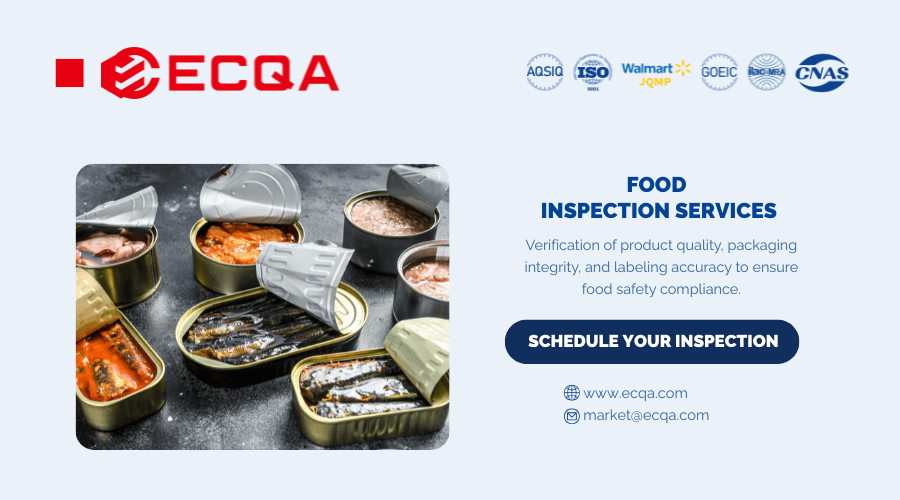
ECQA Food Inspection Services Service Overview
Food inspection supports quality assurance and compliance by verifying that products match agreed specifications and meet basic safety expectations for shipment and sale. ECQA conducts on-site inspections using standardized methods and clear acceptance criteria, aligned with client requirements and applicable food labeling expectations.
Inspection coverage can be applied at production sites, packing locations, warehouses, and before shipment, depending on the risk profile and supply chain stage.
Key Aspects of Food Inspection
- Appearance and condition checks: Inspections review visible condition, contamination indicators, damage, foreign matter risk indicators, and overall presentation based on product type.
- Sensory assessment: For applicable products, inspections assess appearance, color, texture, and observable freshness indicators. Odor checks are included when relevant for spoilage risk screening.
- Quantity and weight verification: Net weight, unit count, and dimensions are checked against declared specifications and labeling claims, including tolerance checks where required.
- Packaging inspection: Packaging is evaluated for sealing quality, leakage risk, punctures, tears, deformation, and overall protection performance for storage and transportation.
- Labeling and marking verification: Ingredient list, allergen declarations, nutrition information, batch or lot code, production date, expiry date, storage conditions, country-of-origin information, and required statements are reviewed for completeness and consistency with provided specifications.
- Handling and storage observation: Where conditions allow, inspections review basic handling and storage environment observations that may affect product integrity, including cleanliness indicators and segregation practices.
Types of Food Defects or Risks Typically Found
- Damaged or compromised packaging seals
- Leakage, swelling, dents, or deformation that may indicate handling or integrity issues
- Incorrect or missing expiry date, production date, or batch code
- Allergen declaration missing or inconsistent with specification
- Label content errors in ingredients, net weight, or country-of-origin
- Poor print quality or illegible markings affecting traceability
- Foreign matter indicators or contamination concerns based on visible checks
- Abnormal odor indicators suggesting spoilage risk for relevant items
- Incorrect unit count, net weight deviations, or fill-level inconsistencies
- Mixed lots, incorrect assortment, or incorrect product variant
Why Food Inspection Is Important
Safety screening: Inspection helps identify condition issues, packaging integrity concerns, and labeling risks that may affect consumer safety.
Regulatory alignment: Food inspection supports conformity with labeling and traceability expectations for the intended market.
Quality consistency: Product condition, packaging, and net content are assessed before goods move to distribution.
Risk mitigation: Identifying issues early in the supply chain helps reduce complaints, returns, and shipment disputes.
Food Product Categories We Covered
- Fresh and processed fruits and vegetables
- Seafood and seafood products
- Meat and poultry products
- Dairy and egg products
- Beverages and alcoholic drinks
- Confectionery and bakery products
- Processed and packaged foods
- Condiments and seasonings
- Nutritional and specialty food products
Locations We Covered
ECQA conducts inspections across China, Vietnam, Thailand, Malaysia, Indonesia, South Korea, Japan, India, Bangladesh, Pakistan, Turkey, Kenya, Egypt, and multiple other regions worldwide.
ECQA provides independent third-party food inspection services covering product condition checks, packaging inspection, net content verification, and labeling review to support quality control and compliance needs.
Food inspections can be arranged through ECQA across major manufacturing regions in Asia, with additional coverage in Europe and other global locations based on project requirements.
A food inspection checklist typically includes appearance checks, sensory screening where applicable, net weight or quantity verification, packaging inspection, labeling and marking verification, and batch traceability checks aligned with product specifications and market requirements.
Related Inspection Services
- Free consultation
ECQA provides flexible options for your food inspection requirements. Inspection coverage can be aligned with your specifications or standard industry practices.


 Request Free Sample Report